When I started this, I wasn’t sure where I would end up. I had a newsletter deadline
coming up, but no story ideas. I checked with my old pal and fellow newsletter author,
Gerhard. He said he didn’t have anything in the works either. What to do, what to do?
Well, an old standby to kickstart the creative juices is to go out and buy a new gun!
Recently I wrote about getting matching Ruger
Wrangler single action .22 cowboy pistols for my brother and myself. Though
single-action sixguns have significant drawbacks compared to more modern designs,
you can’t deny that they can be a lot of fun considering their call-back to history,
and because of the relaxing pace at which they must be loaded and unloaded.
Up to the recent acquisition of that Ruger Wrangler, I had not given single-action
revolvers much interest in many years. One of my earliest firearms was a Ruger
Blackhawk Convertible, 6½” barrel, with both .357 Magnum and 9mm cylinders. I
actually took my first “big game” with that gun, a javelina back in 1994, using
115 grain 9mm Remington Golden Saber hollowpoints.
I eventually disposed of that revolver, but ended up owning another one after
friend and longtime club member Bob Martin “crossed the river”. I still have
Bob’s Blackhawk today and though I use it rarely, I cherish it.
So the two Ruger Blackhawks, a cheap Italian .22, and more recently the .22 LR
Wrangler have been the sum total of my single-action revolver experience to date.
But after acquiring that Wrangler, a fresh spark was lit. I noticed that
Sportsman’s Warehouse had some cool-looking cowboy guns in stock, by Pietta, an
Italian maker of quality Colt Single Action Army clones, imported by EMF in
California.
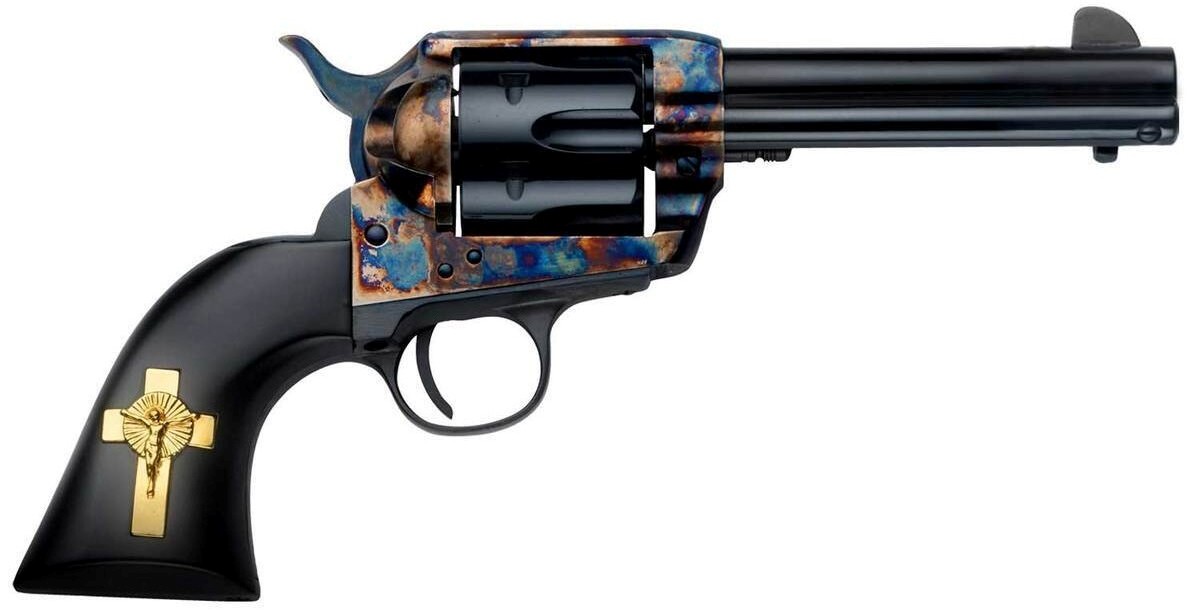
The one that caught my eye was “The Hand of God”, a replica of the Colt SAA that
Russell Crowe wielded in the 2007 movie, “3:10 to Yuma”. Besides all the exciting
Old West action, I also enjoyed the movie because of the Arizona connection.
Though I kept drooling over that hog leg, I could not bring myself to shell-out
the mid-$700 price that they were asking for it.
Eventually, I stumbled into looking at the less-pricey Piettas. When I filtered
and sorted the Sportsman’s website for Piettas in-stock or orderable, price low
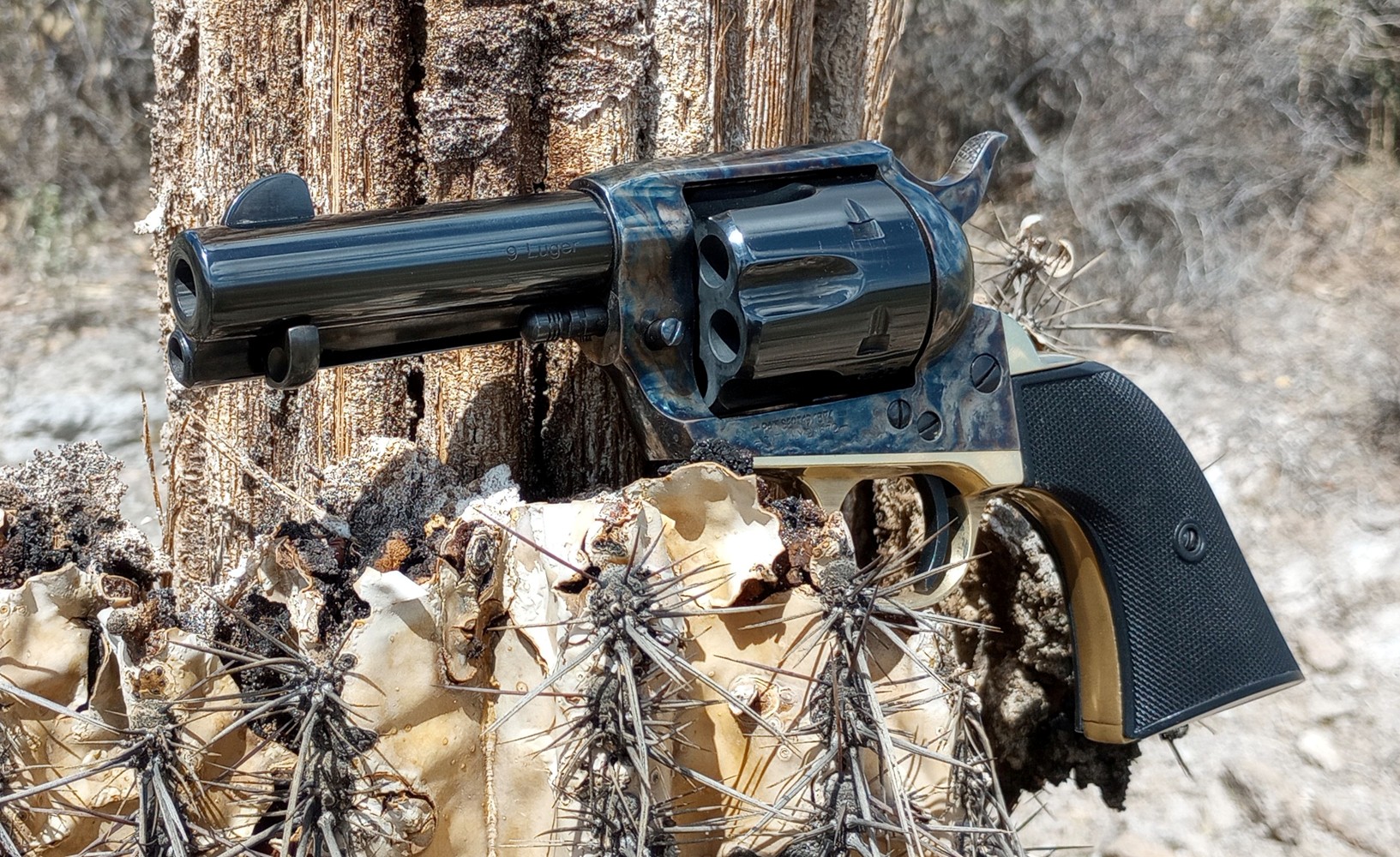
to high, my wandering eye was drawn to one on sale, chambered in 9mm. With a
shorter-than-usual 3½” barrel, the model was called the “1873 Great Western II
Gunfighter”. This Pietta was about $200 less expensive than the Hand of God model.
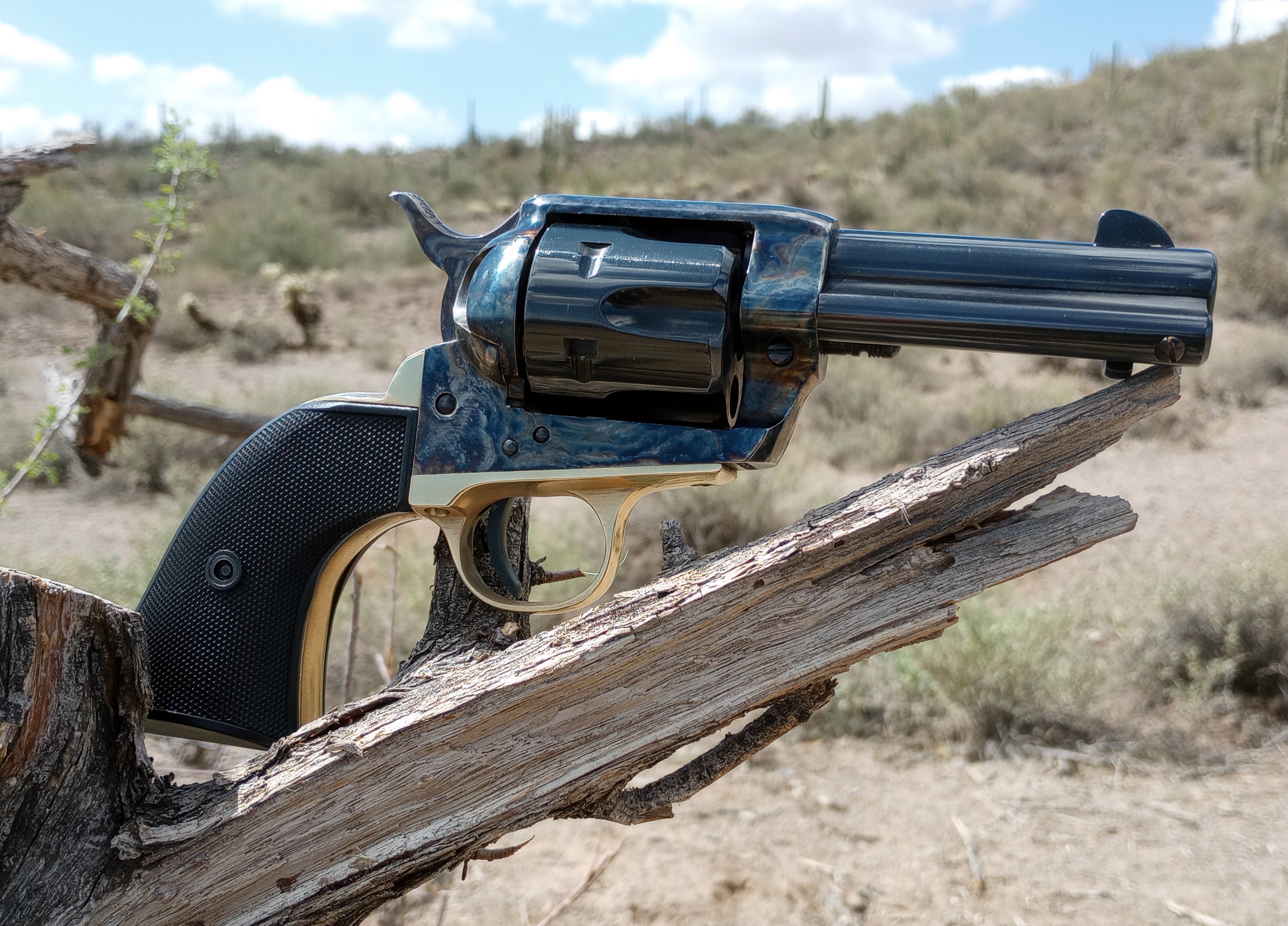
Characterized by a brass grip frame and trigger housing and slim black plastic
checkered grips, the Gunfighter models were introduced at SHOT Show in 2020.
The main frame is beautifully color-case-hardened. Pietta does a really good
job with this. The barrel and cylinder are high-polish blued. I think it’s a
very attractive pistol. My wife on the other hand is not a fan of the brass.
She says it’s too much “bling”. Available chamberings are .45 LC, .357 Mag, and
9mm. The short barrel Gunfighter is only available in 9mm. The others have a
barrel length of 4¾”.
Though 9mm is also available in the more-normal 4¾” barrel length, it was the
shorty that was calling to me. The shorter barrel seemed especially fitting
in 9mm caliber.
Three-and-a-half inches or thereabouts is a normal barrel length in 9mm compact
carry size autopistols. The ammo is cheap, available everywhere, and mild-recoiling.
This will make the Pietta shorty a fun gun to carry and to shoot often.
You may be wondering whether moon clips are required. The answer is no. Moon clips,
half-moon, or “stellar” clips are used in swing-cylinder double action revolvers
chambered for rimless cases, but they are not needed for single action revolvers,
because of the different ejection system. Single actions are loaded one round at
a time, and the empties are ejected one case at a time. Headspacing is on the case
mouth inside the cylinder.
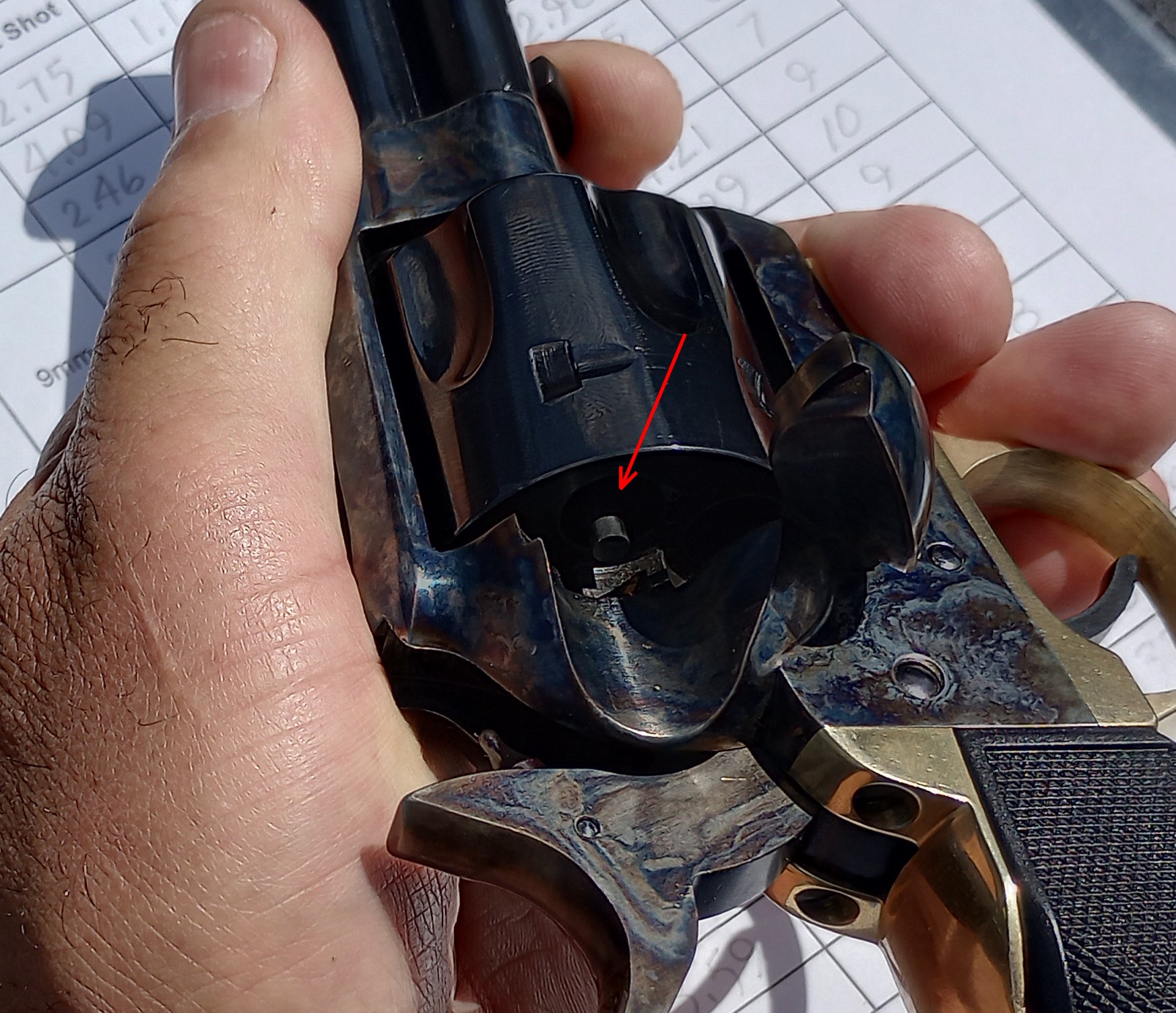
Short ejector rod barely pokes out of cylinder at full stroke.
|
The other factor that attracted me to the shorty was that I thought that it would
be more comfortable to carry in the wild than a longer barrel SAA. Regular
readers know how much I love my “carry just because” trail guns.
Coming home with the shorty was not a slam-dunk though. When I arrived at the
store, I asked to look at both versions of the 9mm Gunfighter. What I feared was
that due to the short barrel, that the ejector rod would be similarly short, and
that ejecting fired cases would be a pain-in-the-ass. Indeed, what I saw was that
the ejector rod just barely pokes out of the cylinder when pushed fully back.
At the store, I went back and forth between the two. The decision was harder
than I thought it would be. Finally, I made the leap of faith to just go ahead
and buy the one that brought me to the store – the shorty.
When I got it home, the first thing I did was put an empty into the cylinder and
test. No problem! With a brisk stroke, and an assist from gravity, the cases
come flying out.
But it turns out that there is a different problem due to the short barrel that I
did not anticipate. Removing the cylinder base pin to remove the cylinder for
cleaning is tricky. With the ejector button fully forward, the base pin hits it
before the pin clears the frame.
But Pietta has a solution for that. The crescent-style ejector rod button runs
in a channel in the ejector rod housing that has a twist at the end. In the
relaxed position, the button nestles up next to the barrel as it should. But as
you push the button back, it rotates downward, due to the twist in the channel.
This allows the base pin to slide past the ejector button when the pin is pulled
to remove the cylinder.
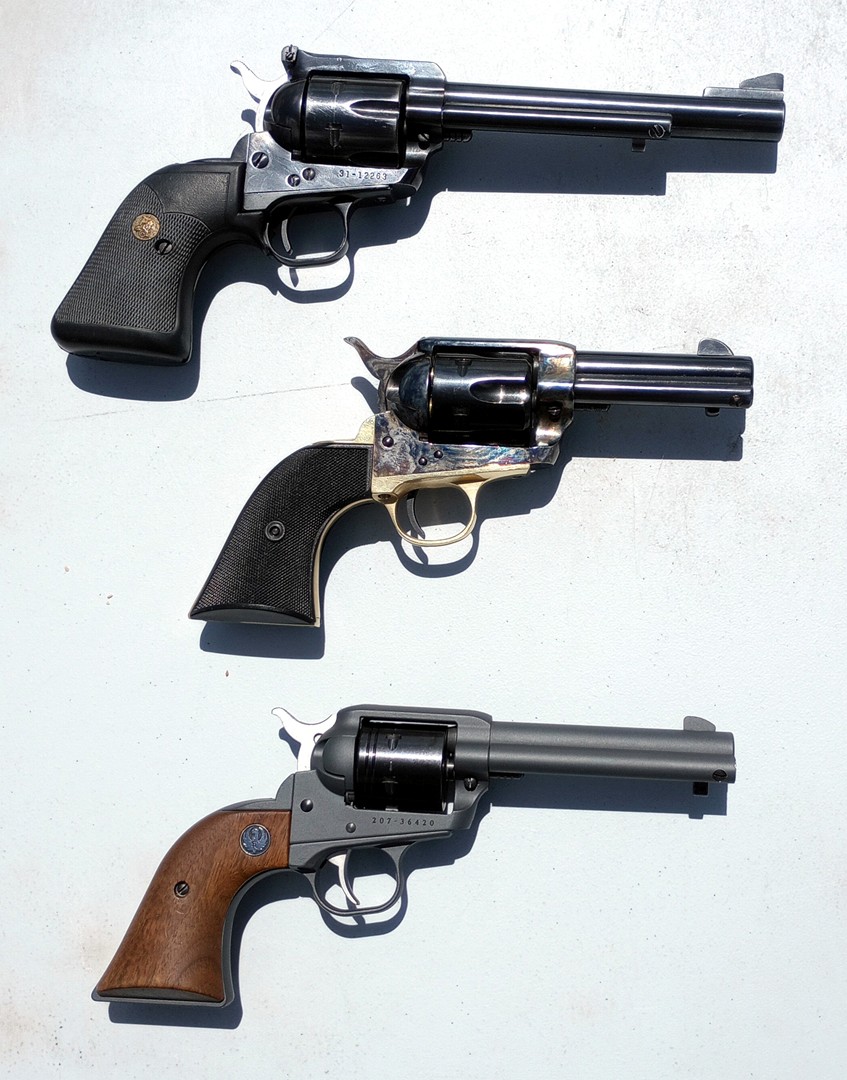
Dan’s current single action revolver battery:
Top, Bob Martin’s .357/9mm Ruger Blackhawk;
Middle, Pietta 1873 Gunfighter 9mm shorty;
Bottom, Ruger Wrangler .22 LR.
|
Instead of a two-finger operation (depress the base pin latch button as you pull
out the base pin), it becomes a three-finger operation: Push the ejector rod
back until it rotates. About half-way back will do. Depress the base pin latch
button and pull out the base pin. This is not easy. I found that a stubby flat
blade scewdriver placed in the groove at the end of the base pin gave me the
leverage needed to pull out the base pin as two other fingers were busy depressing
spring-loaded buttons. This is the sacrifice you must make to enjoy the benefits
of the short barrel.
Comparing my Rugers to the Pietta, it’s evident how Ruger has gone its own way in
redesigning the classic single action revolver in ways they deem to be improvements:
beefed up frames, adjustable high-profile sights, transfer bar safety system,
changes to the internal lock mechanism, and modern finishes.
The Pietta remains true to the original Colt design with the famous 4 click
hammer cock. Okay, Colt never chambered for 9mm, and never had brass grip frames
and trigger housings on the Model P. But mechanically, operationally, it is the
same as an original Colt SAA.
Given the 9mm caliber, and because the short barrel of this Pietta makes the pistol
close to the same overall size and bulk of many of today’s compact (but not micro)
defensive handguns, guns that you might carry beneath a cover garment, the question
that became the title of this story came to mind. Could an old west sixgun be a
viable tool for self defense today?
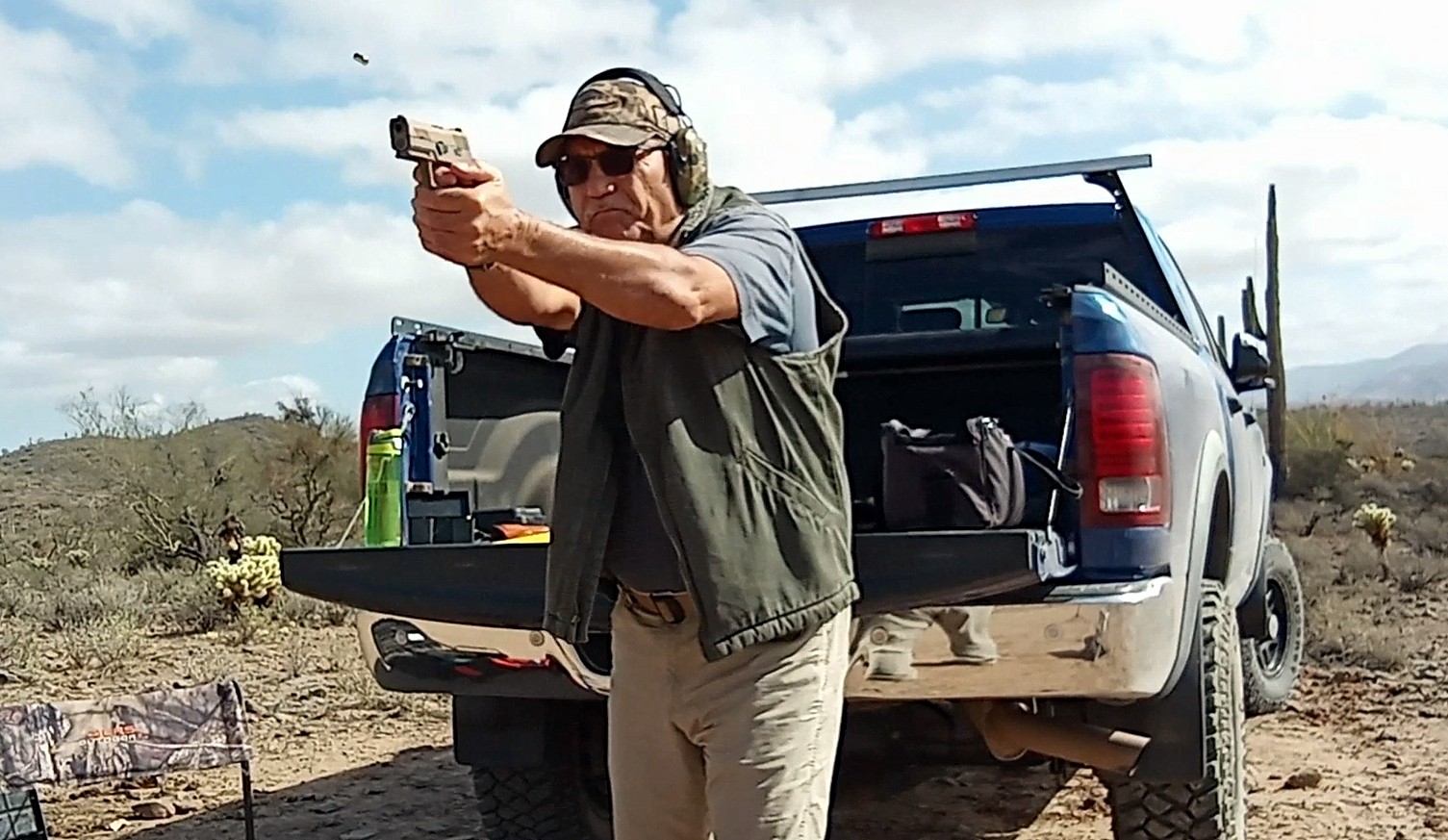
To answer that question and more, I devised a test. I went to my armory and picked
out four other mid-sized handguns of different operating systems to run a comparison.
I would shoot three shots from concealed draw as fast as I could into an HSC bullseye
target at 7 yards for time and score.
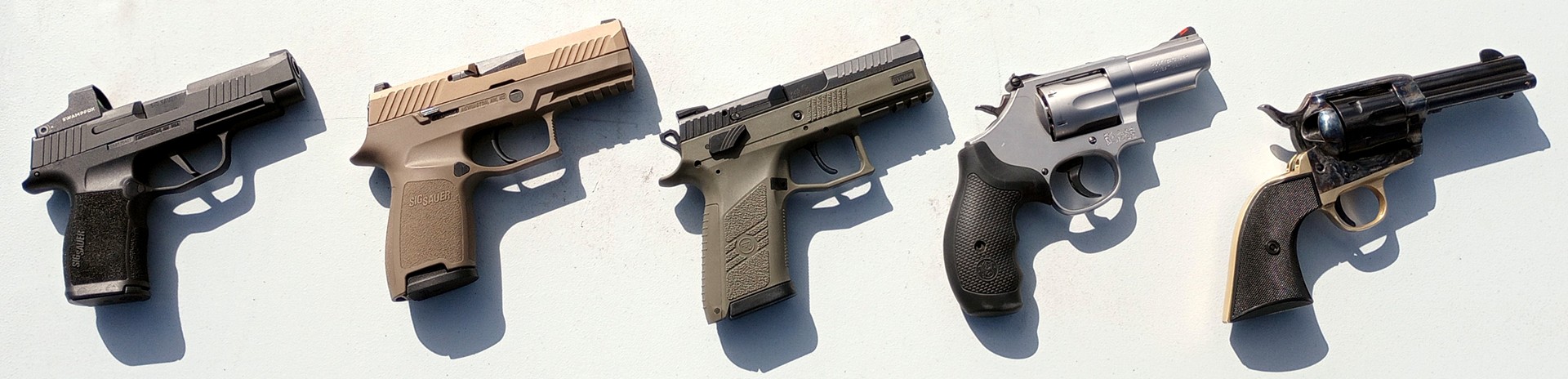
Comparing five different mid-size pistols for their suitability for defensive carry:
From left to right:
SIG Sauer P365XL 9mm with a Swampfox Sentinel red dot sight; SIG Sauer 9mm P320 Compact;
CZ P-07 DA/SA 9mm; Smith & Wesson Model 66 .38 Spl/.357 Mag; Pietta 1873 Gunfighter 9mm shorty
|
I would make three runs for each of the guns. I would then tabulate all the numbers
to try to come up with some sort of a figure-of-merit to rank them from best to worst.
I chose to make three runs for each because I knew that there would be some
learning/training for each gun as I made more runs. For the Pietta in particular,
what’s the best way to cock the gun between shots? How do you two-hand hold a single
action cowboy gun after having been ingrained in the Modern Technique of the Pistol?
The cowboys didn’t shoot them that way!
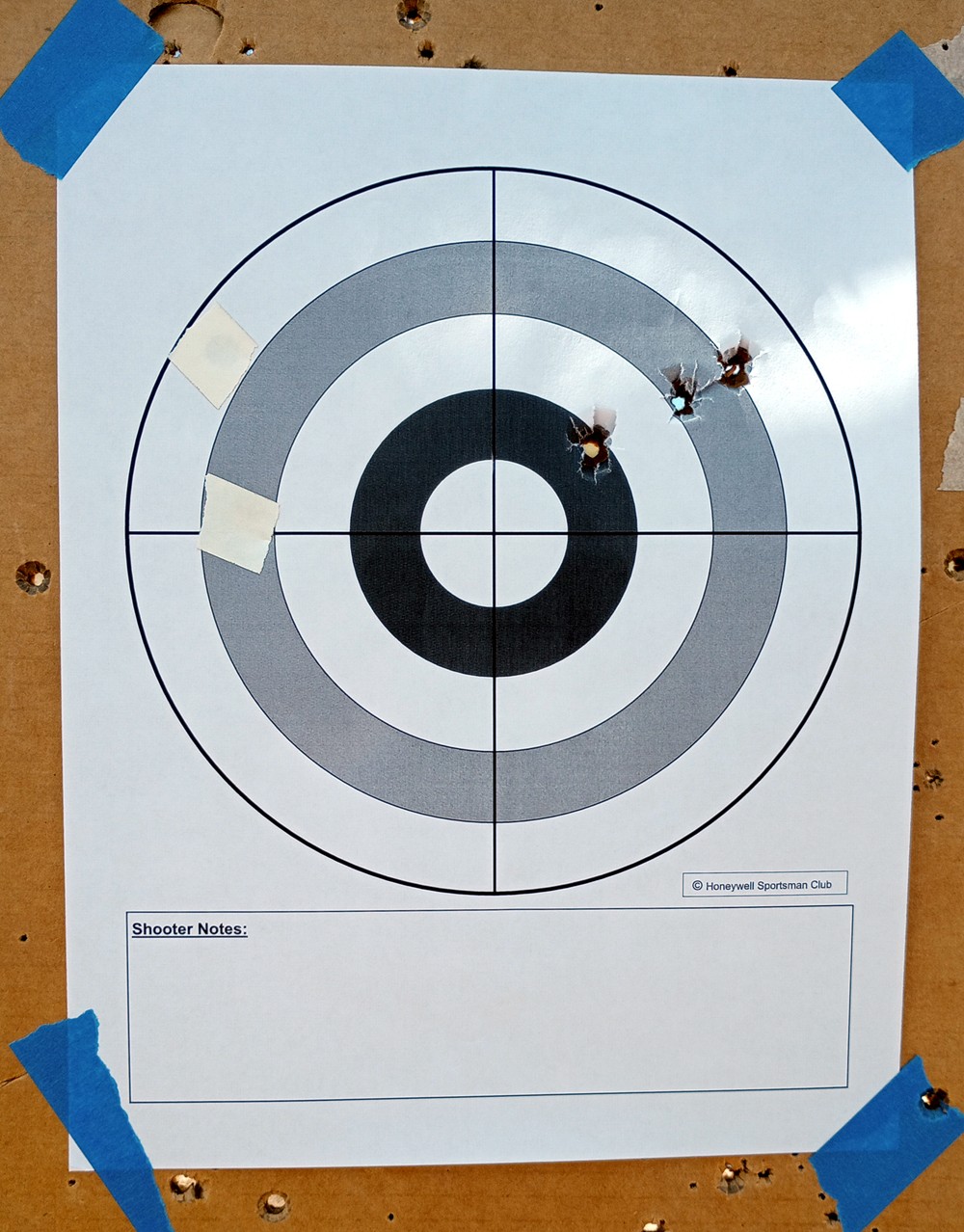
The HSC bullseye target I’m talking about is one that I came up with fairly recently
and added to the Computer-Printable Targets page on our website. It looks like this:
Overall, it’s a 7½” diameter circle broken into 5 concentric rings, each ¾” thick.
The target is not printed with any score values, but for this test, I assigned point
values of 5 through 1 from the center outward.
A major goal of this test was to compare the different operating systems of these
5 guns. The two SIGs were both striker-fired, but one was iron-sighted, while the
other wore a red dot sight. Here I was not testing the difference between operating
systems. Rather, I was comparing the sighting systems, another question that I
wanted to answer.
Next was the CZ P-07. In the landscape of modern defensive pistols, it is somewhat
of a rare bird. The double action/single action hammer-fired semiautomatic
operating system saw its heyday perhaps back in the 1980’s, in the time before
polymer pistols. With a polymer frame, this CZ is a modern take. It is a DA/SA
semiautomatic with a decocking lever. The sights are three white dots.
The only other polymer DA/SA pistols that I can think of today are the SIG SP2022
and the Taurus TH series. There may be other CZ-type polymer pistols that I am
unaware of.
I also added a double action revolver to the mix, a Smith & Wesson Model 66 Combat
Magnum with a 2¾” barrel. I would fire it only double action in this test, as one
would for defensive purposes. That is something that I am definitely not practiced
at. I chose to make two runs (of three targets) with this gun. One run I would make shooting .38 Special ammo, and then make another run (of three targets) firing .357
Magnum ammo.
Finally there’s the Pietta 1873 Gunfighter. Well, they do call it the Gunfighter,
right? Seems that we should evaluate it in that light.
SASS (Single Action Shooting Society) competitors can make guns like this really
sing. They are capable of making double and triple taps that sound like a machine
gun by using the “hammer slip” technique. It seems that the guys who are good at
this often use their support hand to cock the hammer between shots. I have no
gunfighting skills whatsoever with a single action revolver, so I was only
comfortable re-cocking with the thumb of my firing hand.
With the fixed sights, my first shots were slow-fire to assess the point of impact.
I found that the shots were hitting to the left of where I aimed. I compensated
by shifting the sight picture to move the front sight to the right edge of the top
strap gutter. That got me closer to hitting the center of target. The Pietta was
the last gun I shot in this test.
I wore a large insulated canvas vest as my concealment garment, as that is what it
would take to conceal guns of this size worn in a strong-side, outside the
waistband holster. Thankfully, a low pressure weather system had moved into our
area on the day of this test, offering a cool breeze which made wearing that vest
comfortable.
I had quality leather pancake holsters for the P365XL and the CZ P-07. I holstered
the SIG P320 in a molded polymer paddle holster. I used my homemade perfect-fit
wet-molded leather holster for the S&W
M66. I got really lucky when I searched my holster drawer for something suitable
for the Pietta. I found a Hunter 1100-series “snap-off” belt holster that was exactly the
right size.
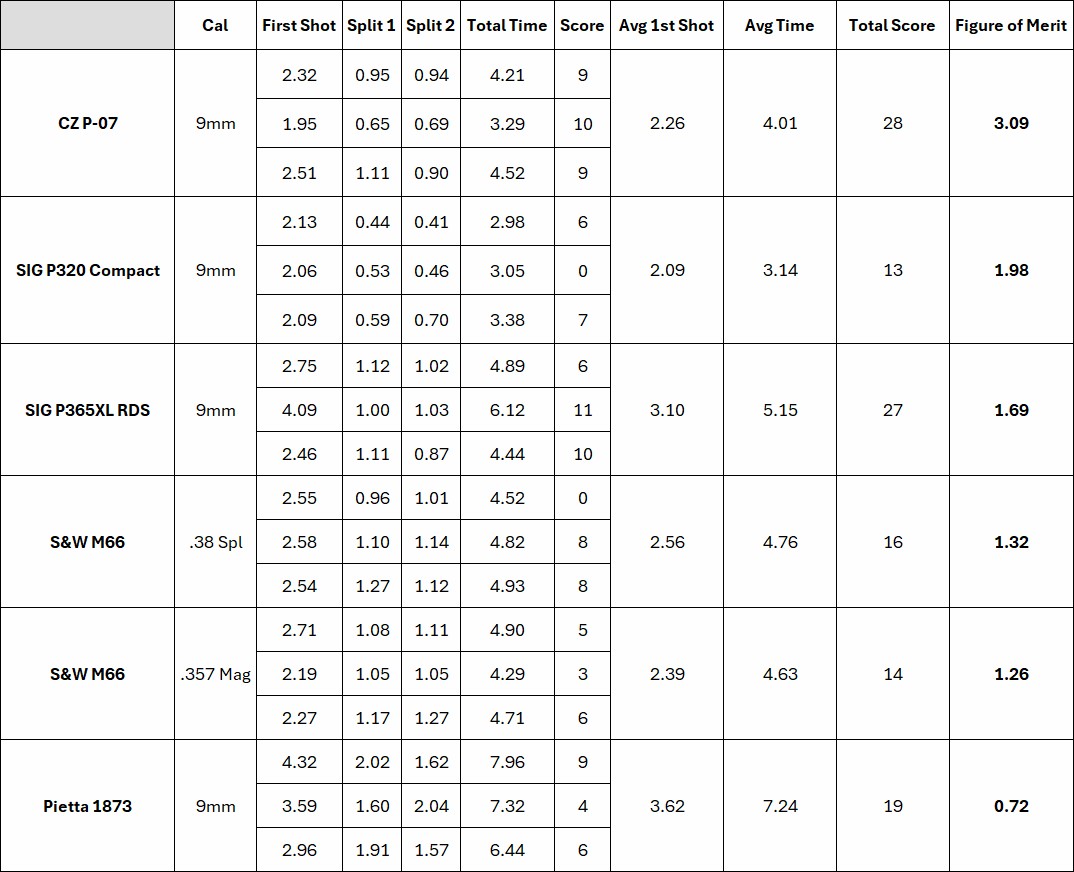
With all of the preamble explanation out of the way, here’s how the numbers shook
out for this very average pistolero:
The chart is sorted by my calculated Figure-of-Merit, from best at the top, to worst
at the bottom. I think you now know the answer to my title question, but let’s dive
in to the reasons that the guns ranked as they did.
But first, how is my Figure-of-Merit calculated? From the three runs for each gun,
I calculated an average time to make the first shot, an average time to make all
three shots, and a sum total score of the three targets fired. Remember that the
hits are scored from zero to five depending on where each shot landed on paper. The
Figure-of-Merit (I didn’t know what else to call it) takes the total score,
representing accuracy, divided by average total time, divided again by average time
to first shot.
Yes, the CZ P-07 stood out head-and-shoulders above all the rest. This is despite
having that disorienting transition from first-shot double action to shots two and
three fired single action. You definitely get the feel of rolling into that first
shot. I did install an M*Carbo trigger spring kit which lightened up and smoothed
the double action pull nicely.
The white dot sights stood out boldly to give a very good flash sight picture. I
scored higher with these iron sights than I did with the red dot sight on the P365XL, surprisingly. Time to first shot was the second-best of them all as well. I like
this gun, even though I haven’t shot it that much. It was eye-opening to see how
good it could be, and now I like it even more. As a carry gun, to have it standing
by decocked at my side gives great peace of mind. It is not a pistol that will go
off accidentally. You can’t buy a new CZ P-07 anymore. In 2024 it was replaced by
the P-09C Nocturne, which is basically the next gen.
Let’s now move from best to worst and talk about the Pietta. You can see that
getting off the first shoot took nearly as long as taking all 3 shots with the CZ.
That’s the manual cocking penalty, plus the time needed to adjust the sight-hold
after sight acquisition to place the front sight at the right edge of the top strap
gutter. It’s a big workload under stress. Re-cocking and sight re-acquisition is
also reflected in long split times and in the longest total time figure.
Despite all that, I was surprised to see that the accuracy result ended up better
than three other guns (counting the M66 as two guns).
Now it’s worth talking about the P365XL. Notice how it has the longest time to
first shot, except for the Pietta. This gun’s weakness is the time it takes to
initially acquire the red dot in the sight window after drawing. The average
total time is second highest. The split times are not bad, which tells me that
the higher total time figure is mostly due to the initial site acquisition time,
though shot-to-shot re-acquisition is a factor. What moves it up into third place
though, is that once the red dot is acquired, the bullets tend to go where you want
them to. The accuracy figure is the second highest.
The SIG P320 only got into second place based on the lightning-fast times recorded,
certainly not for accuracy which was the worst. Maybe I was pushing that gun too
hard. It was actually the first gun that I put through this test, so I had the
least practice doing this drill when I scored it.
Circling back now to the Pietta: As a trail gun, as a range toy, and as a sweet
shooter, I’m going to enjoy the heck out of it. It’s quite a handsome reminder
of history as well. But for the purpose of self-defense, the U.S. military
obsoleted the Peacemaker in 1892. That doesn’t mean that we can’t continue to
enjoy owning and shooting such sixguns today.