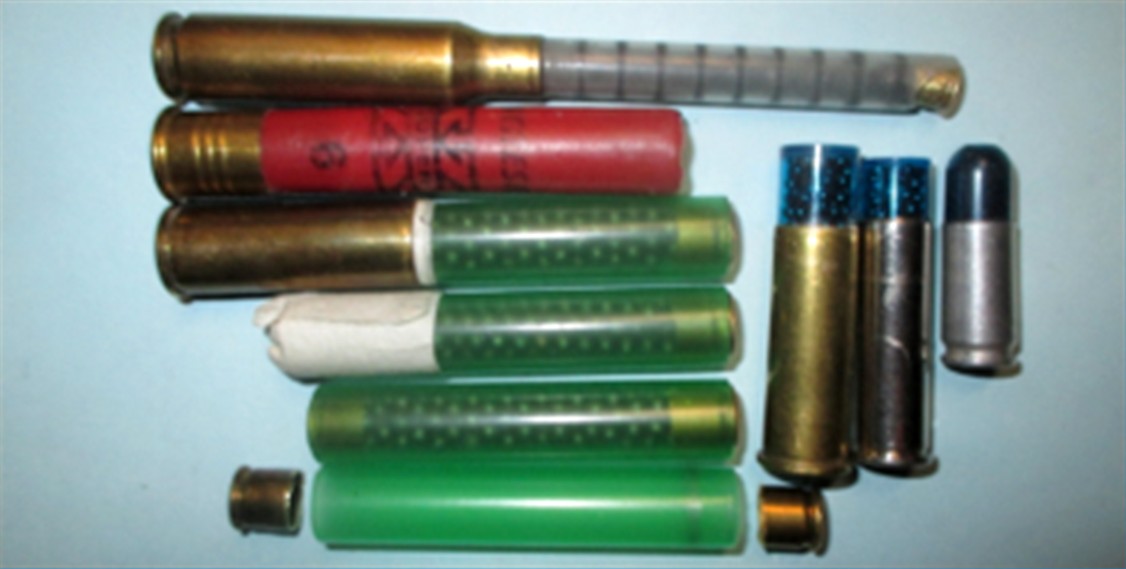
.308 “shot shell”, .410ga 3” shell, .44 mag, .357 mag, and
9mm shot shells in comparison to my 360 gr. 45 Colt “shell”
and its components
|
A .45 Colt/.410 Contender barrel has been in my possession for over 40 years. In .45 Colt,
it bagged at least one javelina. As a .410 bore scattergun it brought down at least one clay
pigeon and for sure several quail. That was years ago, when Arizona seemed to have more rain,
certainly more birds. Somewhere I also have one box of non-toxic .410s, still full though.
Meaning a scenario of floating down a section of the Verde River in my canoe and blasting at
waterfowl never came to be.
Now, in 2025, waiting for the desert to be open for recreational shooting caused some boredom.
Boredom, some say, eventually leads to creativity. Maybe. I did have the following thought,
though: since plastic tubes allowed birdshot to be fired from a high-power rifle, what could
be done with the proper diameter tube in a handgun?? Wait, the T/C can shoot .410s already.
Great comparison platform.
Since a .410 is limited to a 3” shell, with a maximum charge of 11/16 oz. (about 300 grains)
of pellets, could I boost that? And wouldn’t you know, the 2023 Hodgdon Annual Manual, amongst
other recipes, has load data for the .45 Colt (for rugged guns like Ruger, Freedom Arms and
T/C ONLY) for 335 and 360 grain projectiles. Velocities, in their case from a 7.25” barrel,
appeared to be about what other manuals show for 3” .410 gauge reloads. My TC barrel measures
10 inches. Also, unlikely that in my Contender I will get listed .410 gauge 3” velocities,
probably out of barrels of at least 24 inches. Additionally, I was curious if a larger bore
also demanded larger pellets for a decent pattern, like the .308 Win. did about a year ago.
360 grains is a 20% increase in payload alone! Who knows about velocity? It did not take too
much effort to load up 5 rounds, loaded with Large Pistol Magnum primers, H4227 powder and #6
lead shot.
When the desert restrictions were eventually lifted, testing could finally begin. First up was
a reloaded .410 ga. 3” containing #7½ shot. That reload was easily 30 years old, fueled by 15
grains of 2400. Back then, three of us at work went in together on a MEC, set up for .410 ga.
One of the guys also played with a TC barrel, and all of us had kids with their .410 H&R single
shots. Reloading made sense then. Don’t know who ended up with that MEC Junior, but it wasn’t
me.
Anyway, from my bench the first rested and aimed shot reminded me that 300 grains from a handgun
is a little stout, including in pellet form. More impressively yet was the pattern, this from 25
steps away:
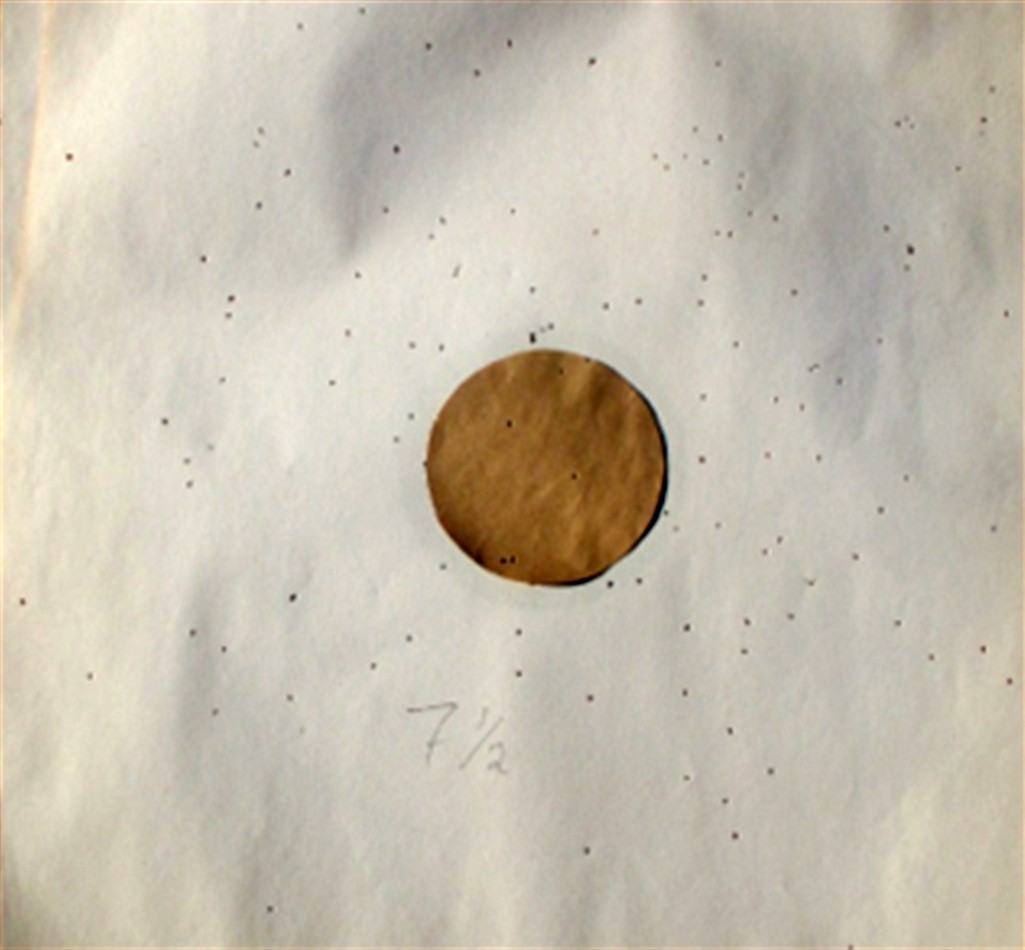
#7 ½ shot at 25 yds: 83 pellets hit within a 15” circle,
of which 8 hit the 4.5” dia center
|
A second shot with #6s also pleased. Previously I had never patterned my T/C barrel on paper,
only across a mud puddle after a rain. That had looked useful – and was, as a few quail
succumbed to my T/C over the years.
Seeing these patterns now on paper, honestly, I
questioned the need to boost the rig by 20%. Good thing, because my first custom “shell”
barely passed gas, a squib load. Turns out my 360 grain shot capsule was stuck in the T/C
choke tube, tight.
Since I could, I tried one more custom shell, now of course without the choke in my T/C barrel.
It went ‘bang’, but barely, with little recoil, and nothing making a hole in the fresh target.
The experiment ended quickly, in total failure. I decided right there and then that another
attempt with a different powder and/or rifle magnum primer or more tape wrapped around the
capsule was not worth it, only because the T/C choke appears quite effective.
Since that choke was out of the barrel anyway, it made sense to launch one more 3” #6 shell
and determine its unchoked pattern.
Bottom Line: my custom 360 grain “projectile” apparently did not generate enough resistance
within the TC barrel that the powder charge never developed proper working pressure. Luckily,
that barrel in its original .410 ga. is quite potent. Even without choke tube it could bring
down small game within 25 steps.
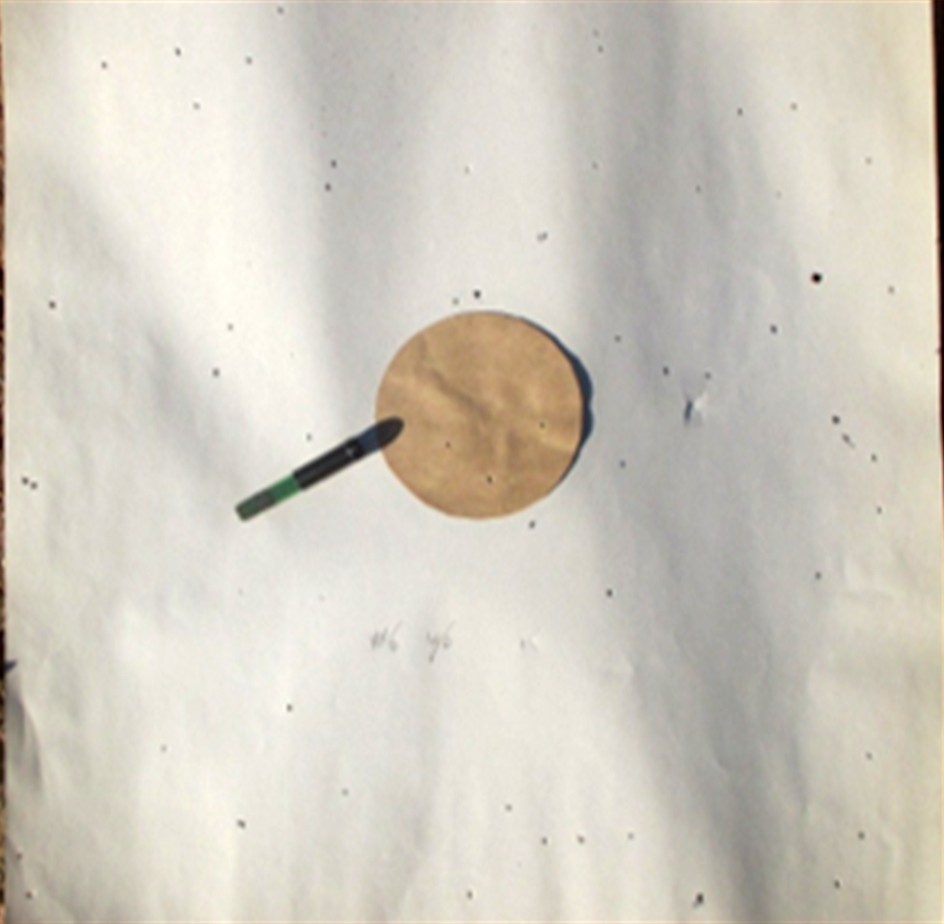
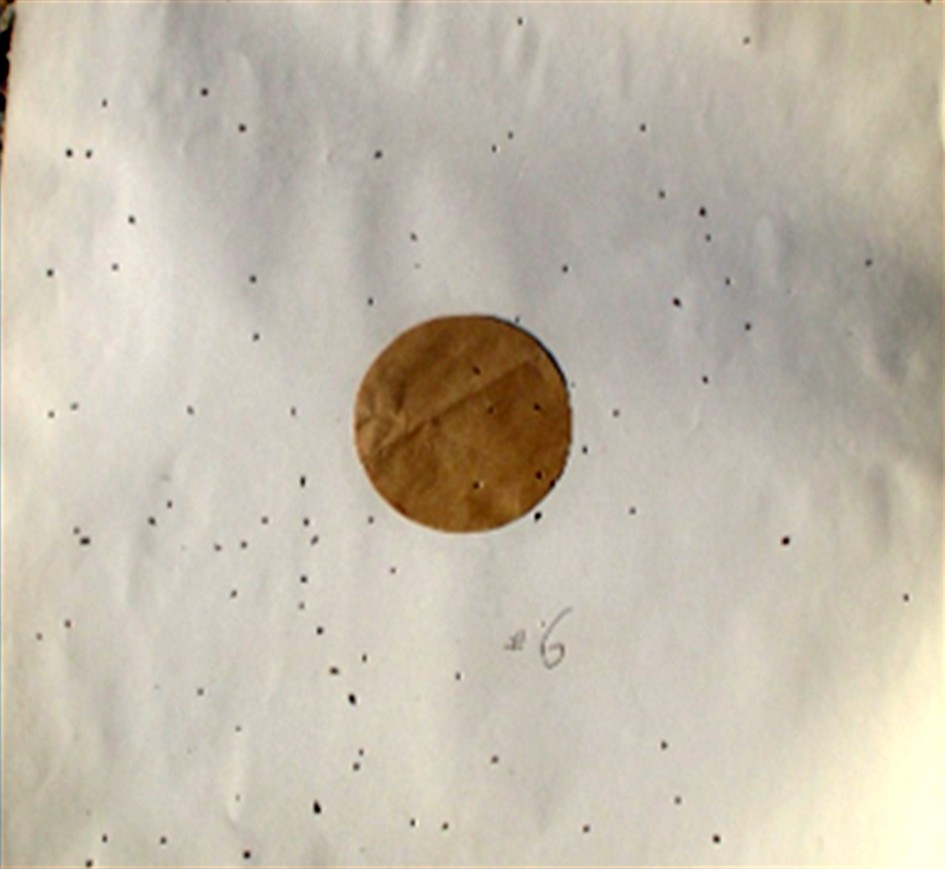
#6 shot at 25 yds without choke: 20 pellets hit within a
15” circle, of which 3 hit the 4.5” dia center
|
Too bad that recently the quail population around here is not great. I like eating them.
That’s why the challenge of chasing them with a .410 Contender is too much of a handicap for
me currently. But I’m ready to!
Can the .45-70 be used as a shotgun?
Yep, I have made a third attempt converting a rifled firearm into a shotgun. It had been a
short-range success firing shot from rifles chambered in .308 Win, 8mm Mauser and .375 Durham.
Those results suggested that any caliber in-between could equally be made to shoot shot. Then
came the utter failure trying to boost shotgun performance in my .45 Colt/.410 Contender barrel.
What remained was: Does a larger bore also demand larger pellets for a decent pattern, as had
been the case for the .308 Win.?
Well, I do have a .45-70 barrel to try this home-made shotshell concept with. Again, the 2023
Hodgdon Annual Manual provided data, including for a 500 grain bullet. Long story short, the
reusable straw I employed as a shot capsule just fits inside that .45-70 muzzle. To fashion a
“bullet” of no more than 500 grains, 3.2” of the straw, plus the end plugs made from .32 ACP
cases, cut down to about half their length, and 7/8 oz. of pellets did the trick. Included was
also 4.5 inches of tape wrapping to obtain a snug fit inside a fired (not re-sized) .45-70 case.
Punch out the old primers, re-prime with Large Rifle Magnum, add AA 5744 powder, slide in the
capsule, and you have 45-70 shotshell ammo. I made two to try.
Note that a .410 ga. 3” shell will not easily go into a .45-70 chamber. If one’s life depended
on it, at least for my .45-70 barrel, I could probably force in it there. A fired shell would no
doubt only come back out with a stout rod inserted from the muzzle. Meaning that the plastic
from a .410 ga. hull will not work as shot capsule in a .45 cal. barrel.
Note also that 7/8 oz. is the load of pellets contained in typical Dove & Quail 20 gauge shells.
And darn, the plastic portion of a .410 ga. shell easily drops into the bore of a .500 S&W. So
why not make a .500 S&W shotshell also?
For that I had to separate the plastic and brass. To plug the driving end (under the tape) I
simply re-inserted a spent shotshell primer. For the front end I used a standard .410 plastic
wad, upside down. With such configuration the .410 plastic tube easily held 7/8 oz. of #6 shot
as well. And the ‘projectile’ total weight was at or below 440 grains, for which there again
is plenty of .500 S&W load data.
Here you go for two of those:
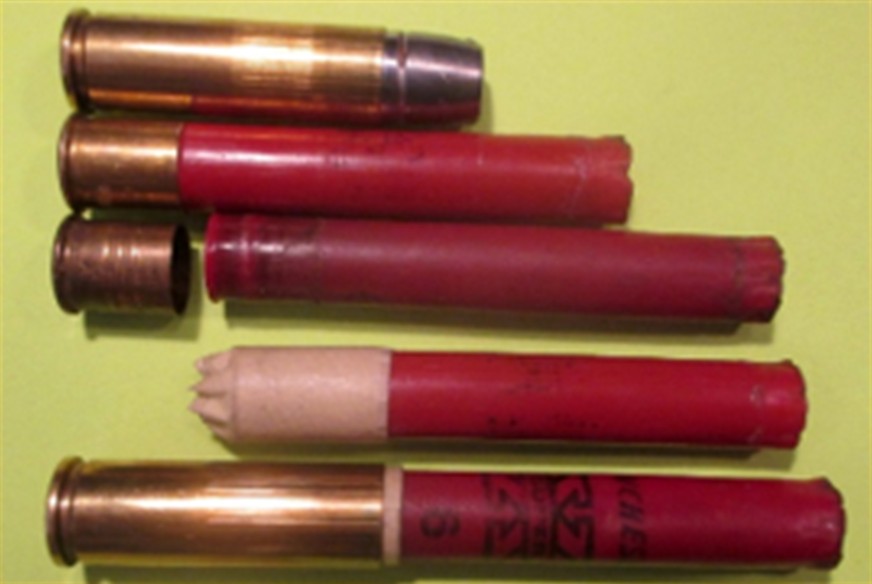
.500 S&W with 440 grain lead bullet, empty .410 3” hull;
separated hull, configured as 440 gr. shot capsule, and
loaded into a .500 S&W case.
Note how my Lee sizer die scratches brass. That would
matter if I were to shoot .500s a lot.
|
Things to consider: In a modern typical shotshell, the wad is a rather flimsy plastic cup,
its sides even slotted. Upon firing and exiting the muzzle, the wad “catches” air, flares out
and thereby separates from the shot pellets, allowed them to spread. The straws used for shot
capsules in the .308 Win. were basically .30 caliber, somewhat brittle. For sure their ride
down the rifle barrel stressed them such that after firing I never found anything of them, leave
alone intact sections.
The green straw for the .45-70 is about .43 caliber, and softer. Similar to shotshell hull
material, but with thicker walls. Will they and the .410 hull tubes release their shot pellets
when exiting the barrels? Or am I simply blasting filled plastic capsules downrange, no doubt
in unstable and uncontrolled flight paths? Only testing will tell.
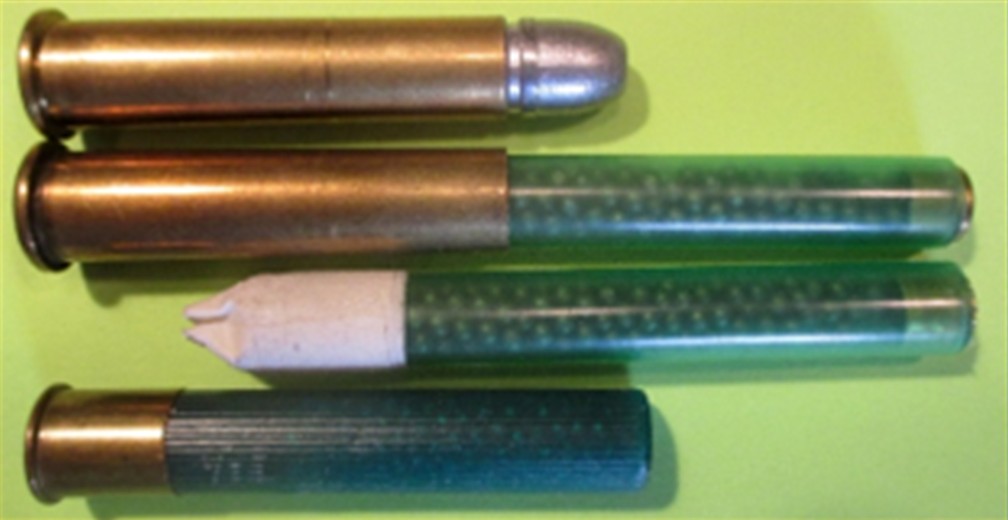
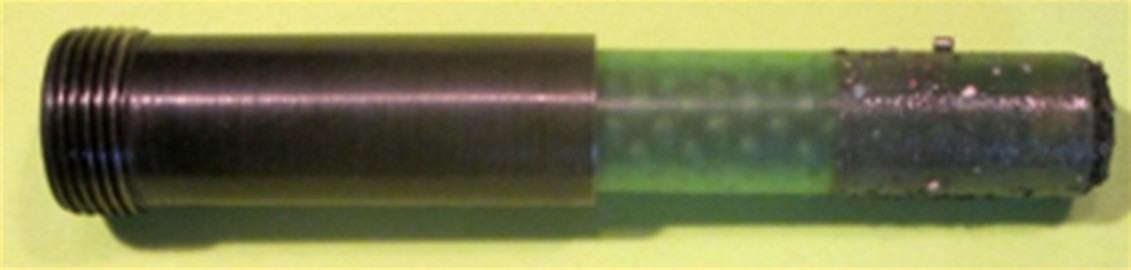
.45-70 with 405 gr. lead bullet; .45-70 with 500 gr. shot
capsule, shot capsule with #6 shot, .410ga shell with #7½
shot for comparison
|
With all that in mind, I opted to set the target at 15 steps. The first shot with the .45-70
generated recoil, but not quite as much as a round with a 405 grain lead bullet. It also freed
the shot charge, as I could see small dust clouds around my target. I’m not sure what all happens
when these plastic capsules are launched through rifled barrels. Since these things do not generate
the recoil a normal bullet does, maybe quite a bit of gas blows past them, and by doing so possibly
partially collapses the plastic inwardly. Whatever, it must be some brutal ride, enough let go of
all the contents.
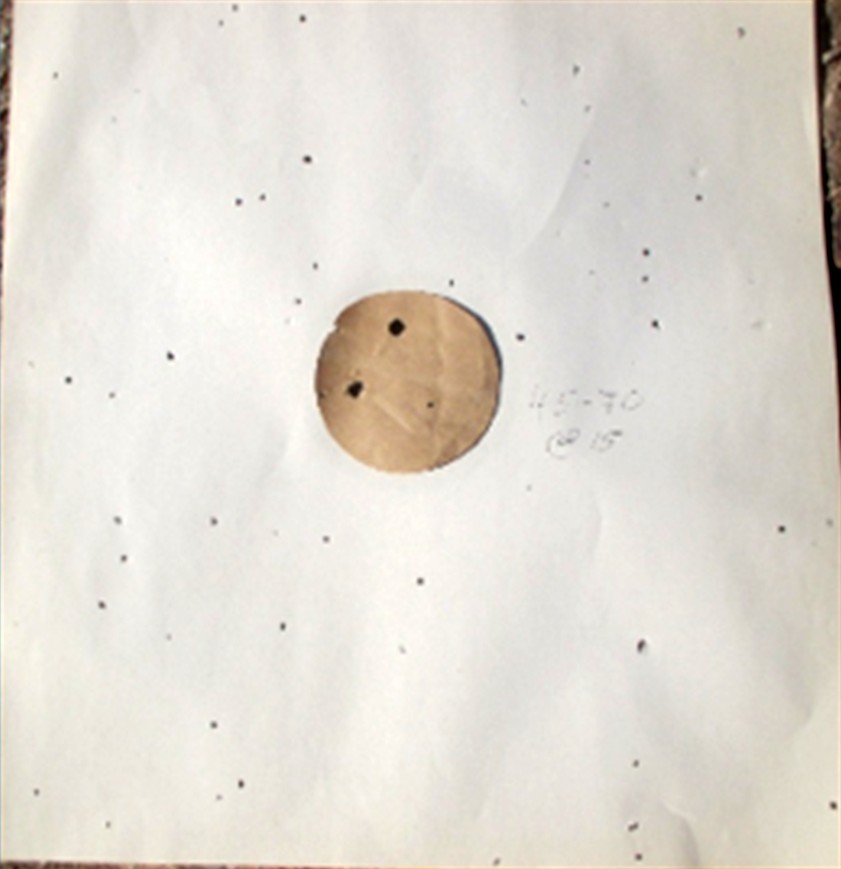
Here's the target:
Interesting that both shortened .32 ACP cases hit the center, whereas the lead pellets spread more
than I wanted them to. At this short distance the load may barely be useful.
The second shot I fired with the target at 25 steps. Only a few pellets hit it along with one of the
.32s. The .45-70 shotshell had already lost its usefulness. The two .500 S&W shotshells spread their
stuff even more.
So, the larger calibers do not offer an advantage with respect to their shot patterns over smaller
bores. Also, from a practical approach it is easy to chamber these overly long shells in my
break-open single shot weapons. Whether that would also be the case for a lever-action I do not
know. Obviously, the .500 S&W shells would never do it in a revolver.
I do have the components. Will I try the .45-70 and .500 S&W again with shot larger than #6?
Probably, some day, when I’m bored enough.