
| Articles | Documents | Equipment | Events | Links | Membership | Miscellaneous | Scrapbook | Targets | What's New |
| Guns for Pocket Carry | June 2022 | ||||||||||||||||||||||||||||||||||||||||||||||
| Dan Martinez | |||||||||||||||||||||||||||||||||||||||||||||||
|
I recently had to head down to my barber’s and get a haircut. I’ve
been using the same barber for about 25 years. I followed him from the
first store where I found him to his second store near 19th and Glendale.
Now I won’t call it a “bad” part of town, but it is definitely not a nice
part of town either.
One time when I was there, I walked past a trio of shady looking
characters, one of which had a 1911 stuffed under his belt around
the back. I had the urge to make a grab for it and take off running
... but I didn’t.
Anyway, before heading out, I felt the need to check my armory for a
pistol that I could take along with me that would conceal somewhere in
the shorts and T-shirt I was wearing. I’m not really that much of a
concealed-carry guy. When I have carried concealed (not often), I
usually use my favorite outdoorsman’s trail gun, a J-frame S&W .327
magnum in a leather OWB pancake holster.
However the T-shirt I was wearing on this day was a little on the tight
and short side, and my normal carry rig just would not conceal. I guess
that I could have changed my shirt to something looser and longer, but I
didn’t feel like changing so I just headed out unarmed. Thankfully, the
haircut was uneventful, as usual.
But that got me thinking about getting a pocket gun – a gun that you don’t
have to “strap on”, but one that you could simply slip into your pocket as
you head out the door.
The Beretta Tomcat and the .32 ACP Cartridge
I wrote about the Model 81 in a newsletter story that I titled
“Second Amendment Social Distancing”,
as that was the buzz phrase being used everywhere when the pandemic started.
I thought that “Social Distancing” was an especially apt metaphor for the main
purpose of civilian carry.
A soldier’s purpose is to destroy the enemy. A policeman’s purpose is to stop
deadly threatening behavior and make an apprehension. But a civilian’s
self-defense purpose is only to stop deadly threatening behavior by causing a
“break in contact”, or put another way, to create “social distance.” .32 ACP
will do that just as well as a more powerful caliber. Most crooks are cowardly
and don’t want to hang around once bullets start flying. Though less lethal,
getting some close-range .32 ACP shots off into a belligerent should do the job
of stopping annoying behavior.
The Beretta Model 81 is not a pocket pistol, but it does carry nicely in an
outside-the-waistband canted pancake holster, which is my favorite carry method,
whether in-town or on the trail. And I have occasionally used it for town carry.
But since I am comfortable with .32 ACP for self-defense purposes, the desire
for a pocket carry pistol led me to the Beretta Model 3032 Tomcat.
While some folks may decide to pocket carry one of the new breed of high
capacity 9mm micro compacts, my criteria for pocket carry was for smallest
possible size and lowest possible weight, while still being of adequate power
to do the job. I am willing to go down to .32 ACP. Other folks may bottom
out at .380 ACP, others will want a 9mm as their minimum.
Gerhard wrote about his Beretta Model
21A in .22 LR back in August of 1996 (“Hmm, that was over a quarter
century ago,” he says). He describes well most of the design features of
these pistols.
Beretta also made a tip-up barrel version of the Cheetah, which as I
mentioned earlier, was a larger, duty-size pistol, not related to these
pocket pistols. This pistol, the Model 86, was chambered in .380 ACP.
All these tip-up barrel Berettas are straight blow-back actions. One of
the side effects of the blow-back design is heavy slide spring tension.
This makes them hard to rack. The tip-up barrel design allows the shooter
to get around the need to ever rack the slide. To chamber a round, one only
needs to tip the barrel up and insert a round directly into the chamber.
Then the barrel is latched back down.
But another implication of this design is that the guns do not have an
extractor. The guns cannot have an extractor because that would not allow
the barrel to tip up. Extraction of a spent case is purely by the action
of gas pressure as the slide is blown back.
The next implication is that a standard tap-rack-bang malfunction clearance
drill, in the case of a bad primer for instance, won’t work. The round would
remain in the chamber. To begin the malfunction clearance sequence for this
gun, with your thumb, press forward on the barrel tip-up latch. This should
fling the live round out of the barrel. Then latch the barrel back down,
then rack, then bang.
The earliest versions of the tip-barrel Berettas were single actions.
Sometime in the 1980’s the guns went to a DA/SA design where the first shot
can be squeezed off with a long, heavy double action pull, with subsequent
shots fired single action from the slide-cocked hammer.
This is a primary feature that attracted me to the gun for pocket carry.
With a loaded chamber in your pocket, that first long and heavy double action
trigger pull gives great peace of mind that you won’t accidentally put a hole
in your thigh while carrying.
The gun also features a positive manual safety at your thumb joint a la 1911.
This gives you the option of cocked and locked carry. Not for me though,
not for pocket carry.
The thumb safety may also be activated in hammer-down, double action mode,
but that is un-necessary to me since you have the first long DA trigger pull.
To put the gun into DA mode, you must pull the trigger and ease the hammer
down manually with your thumb. But due to the tip-barrel design, this can be
done quite safely, by first tipping the barrel up, which removes any chance
of a chambered round being accidentally fired by a slip of the thumb on the
hammer.
There is no slide lock, neither a manual control nor a magazine last-shot
hold-open. The magazine release latch is in an interesting position, toward
the rear, lower portion of the grip. On a gun this small, this is actually a
very good place for it. If it would be in the standard position, at the lower
rear corner of the trigger guard, it would be quite vulnerable to being
accidentally activated during the draw, or during firing. Where Beretta
placed it, it is in a naturally open, ungripped area. Very smart. Intended
activation is easy using the off-hand, where it releases the magazine directly
into that hand (speaking as a right-hander).
You can only get a two-finger grip on the gun. But that is comfortable and
enough. The magazine baseplate juts forward from the bottom of the grip and
slides naturally between your pinky and finger three. Your pinky rests under
the baseplate.
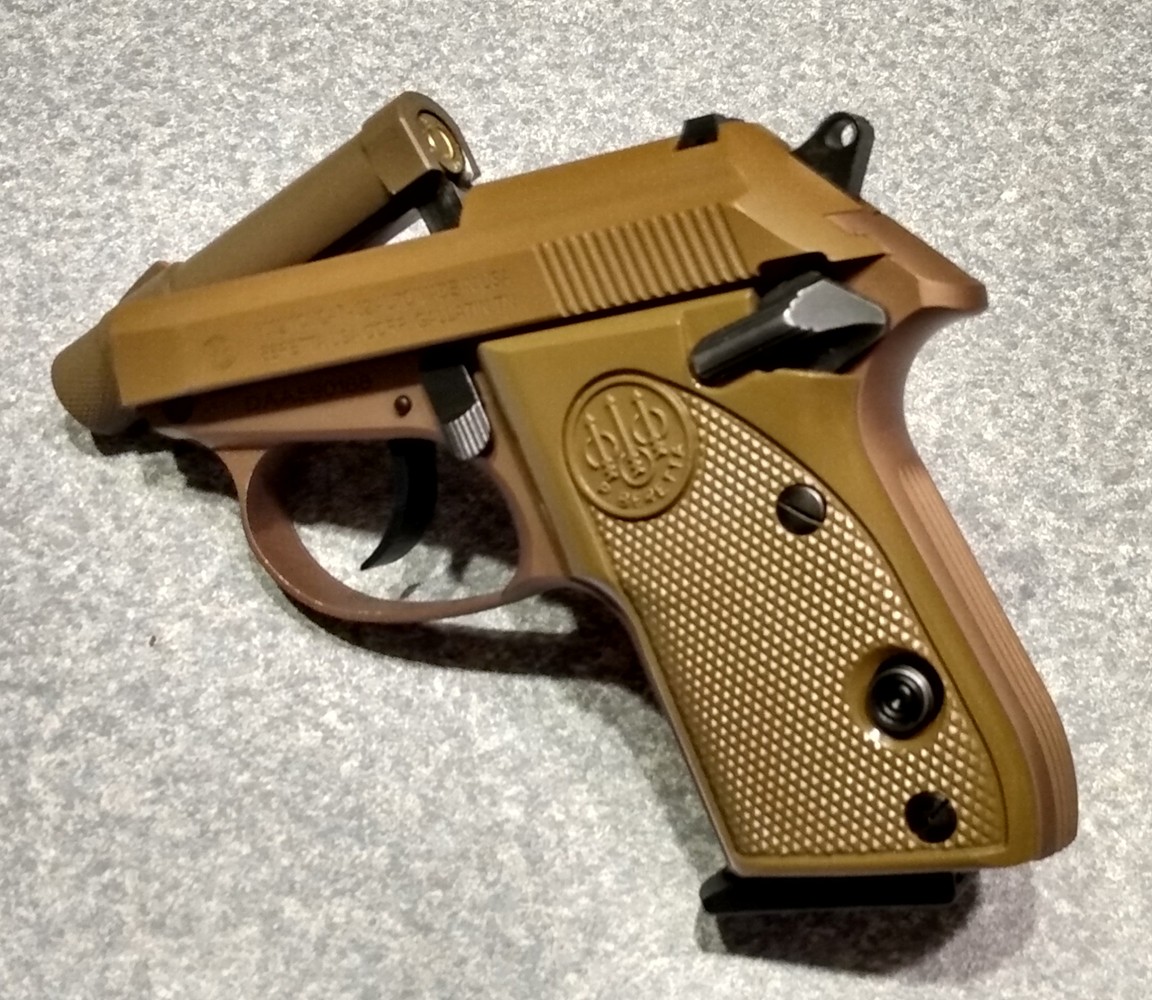
Threaded barrels and FDE options were introduced at the 2020 SHOT Show. When
I went into the store, my intention was to buy the stainless version with
standard barrel. But I inspected the two samples that they had and found
issues. The first had problems resetting the trigger after a double action
trigger pull. The second was impossible to latch the barrel back down after
flipping it open. That was when I said, “Let me see that FDE one.” I
inspected that one and found no issues. Cost was about $100 more for the
threaded barrel and FDE Cerakote, but oh well.
FDE (flat dark earth) finishes became available on both the 3032 Tomcat
(.32 ACP) and the Model 21A Bobcat (.22LR) in 2020. But the FDE finish also
comes only with the threaded barrel, which adds an extra half inch to barrel
length, and thus to overall length. Pertinent specs are:
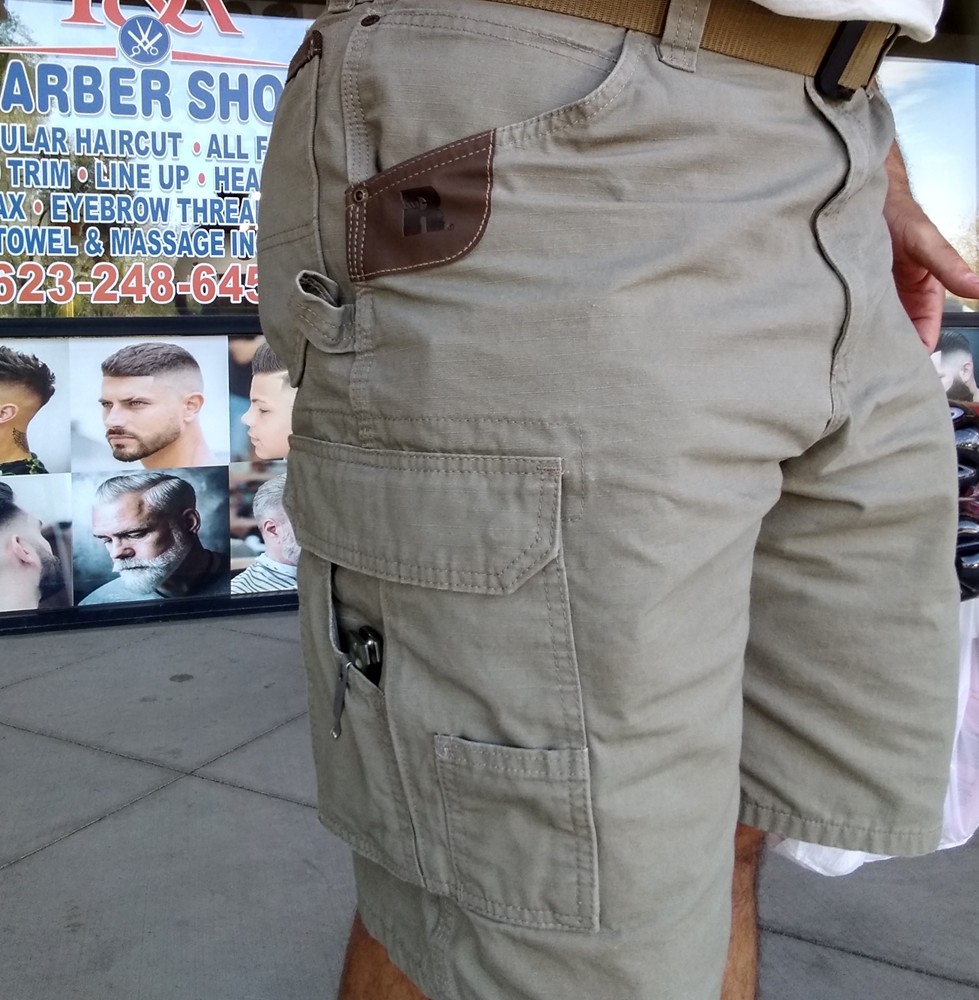
I made a leather pocket holster for the Tomcat, so when holstered, the
pocketed weight ends up at 1 pound, 5 ounces, or 21 ounces. The Tomcat is
sorta thick for a little gun, and it gets a little thicker still when in
the pocket holster. I measured about 1.6 inches thick at the widest place
when in the holster. You definitely feel the width in your pocket, but I
really don’t think that is an issue for carry. People are naturally reticent
about staring at a bulge in that area of a stranger’s pants 😄.
Staring and guessing what you got is just not something that people will do.
Just as a heads up, the Tomcat does have some limitations. It has an
aluminum frame that is known to crack in a specific place when using hot
ammunition. Euro-spec .32 ACP is loaded hotter than U.S. ammo. Beretta
includes a card in the box with a notice stating that the user should stick
with ammo that stays under 130 ft-lbs. of energy. Most U.S. spec ammo meets
this limitation. Beretta recommends several specific loads, but also says
that most 71 grain FMJ practice ammo stays under the 130 ft-lb limit.
I was not aware of this before I bought the gun. I might have thought twice
about buying one had I known this up front. Nevertheless, I still like the
gun and it’s features, particularly, the DA/SA action and the tip-up barrel.
I think these features make it well-suited for pocket carry.
The Ruger LCP Max in .380 ACP
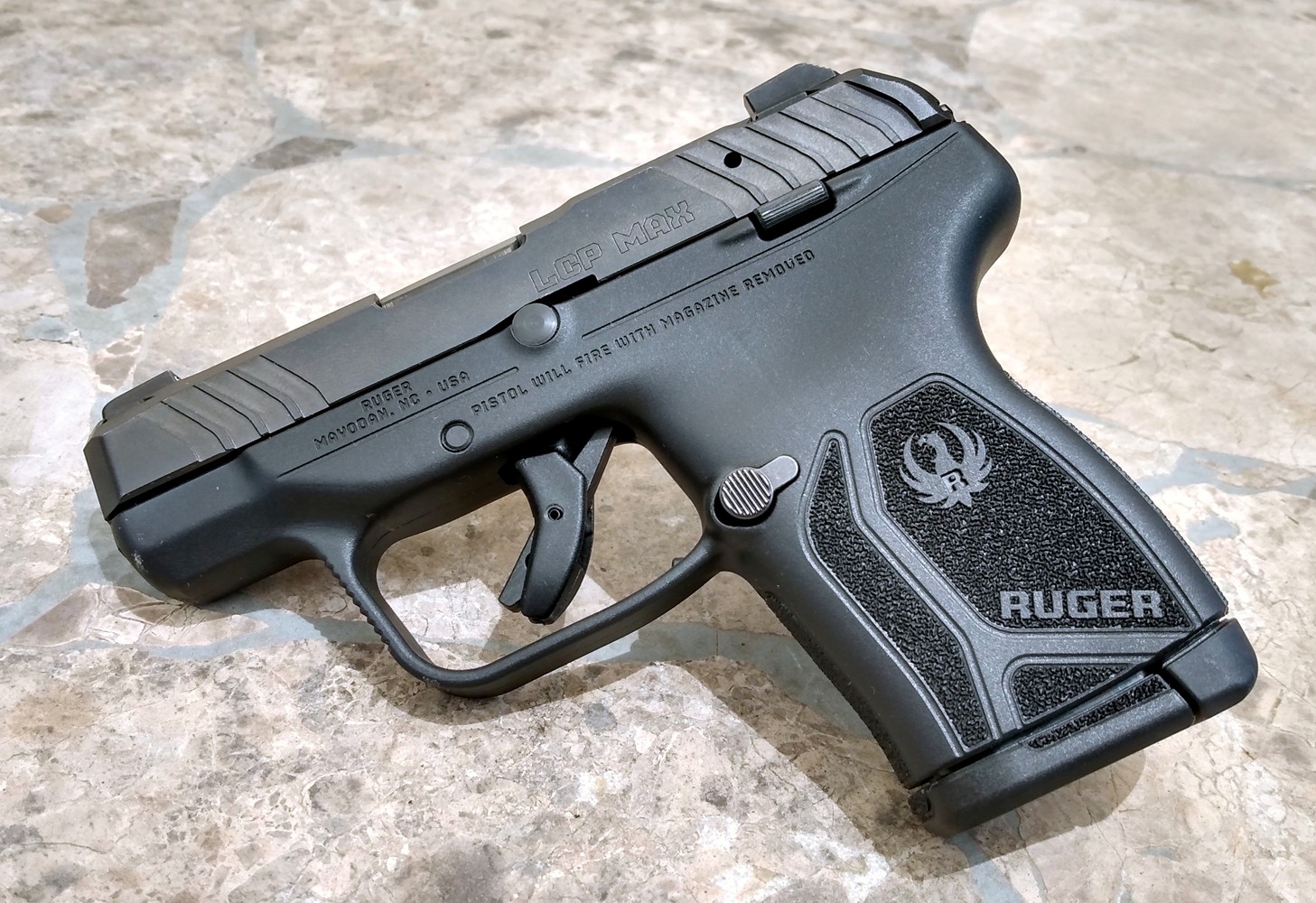
Ruger announced the LCP Max in mid-2021. The Max features even better sights
than the LCP II, retains the Secure Action fire control system, but has been
redesigned to accept a double stack magazine that holds 10 rounds. An
extended magazine is available from Ruger that holds 12 rounds.
Since I was exploring the world of pocket carry, I decided that I needed to
bring home a Ruger LCP Max. For personal defense, .380 ACP is better
accepted as the minimum caliber, versus .32 ACP. Plus this little rocket
will hold 10 rounds in the magazine versus the 7 of the Tomcat. Also it
doesn’t hurt that the (on sale) cost was about half of what I paid for the
Tomcat.
Still, I debated with myself for a couple of weeks about whether I would be
comfortable pocket carrying the Max because basically the action is
single-action only. There is no external safety except for the Glock-like
trigger safety.
The Max is a hammer fired gun. The hammer is housed inside the slide. No
part of the hammer is exposed to the outside, but you can see it cocked
through a notch at the back of the slide. Ruger considers the hammer to
be only partially cocked at rest. There is a very slight amount of
backward and down further cocking motion of the hammer as the trigger is
pulled before the hammer is released. This is a feature of what Ruger
calls its “Secure Action” system.
This is what Ruger says about the Secure Action:
Ruger has a detailed animated video on YouTube that illustrates the Secure
Action fire control system at https://youtu.be/Y0JKkhoynXQ. As described above, the video shows the
secondary hammer catch that prevents accidental hammer fall if the sear and
hammer should become disengaged through external jostling or dropping of the
gun if the trigger is not pulled. From what I can gather, Ruger currently
uses this action design on the LCP II, the LCP Max, the Security 9, and the
Ruger-57 (and now the Ruger LC Carbine).
Unlike the blowback Tomcat, the Max is a typical tilting-barrel locked
breech design. The force required to operate the slide is quite reasonable.
The slide includes a couple of slightly outward extending “ears” at the
back of the slide which aids grasp of the tiny slide for racking. Also the
front edge of the rear sight is square, so that you can rack the slide one
handed by catching it on a table edge, or your clothing for example, then
pushing the gun forward.
The design also includes both a manual slide stop in the usual place, plus
a last shot hold-open feature. The original LCP did not lock the slide
back when empty. The magazine release is also in the expected place at
the left rear side of the trigger guard on the grip. This gun is a much
more conventional design than the Tomcat.
The sights on the Max are great. The front is a Tritium vial outlined
by a white circle. The rear is a U-notch that perfectly nestles the
white circle of the front sight within its radius. The rear edge of the
rear sight is ramped forward to allow a smooth draw without hangup. To
contrast these sights with the Tomcat, the Beretta’s sights are about
half as big, and I had to put a drop of fluorescent orange paint on the
back of the front sight for quicker acquisition. Once I did that though,
I’m satisfied with the Tomcat’s sights, but the LCP Max’s are in a whole
‘nother league.
The Max’s sights are also dovetailed, both front and rear, allowing for
drift adjustability. Earlier iterations of the LCP have fixed sights that
are milled as part of the slide. The dovetails are compatible with Smith
& Wesson Bodyguard sights, so there are even aftermarket options if you
would like to change them. I think they are fine as-is.
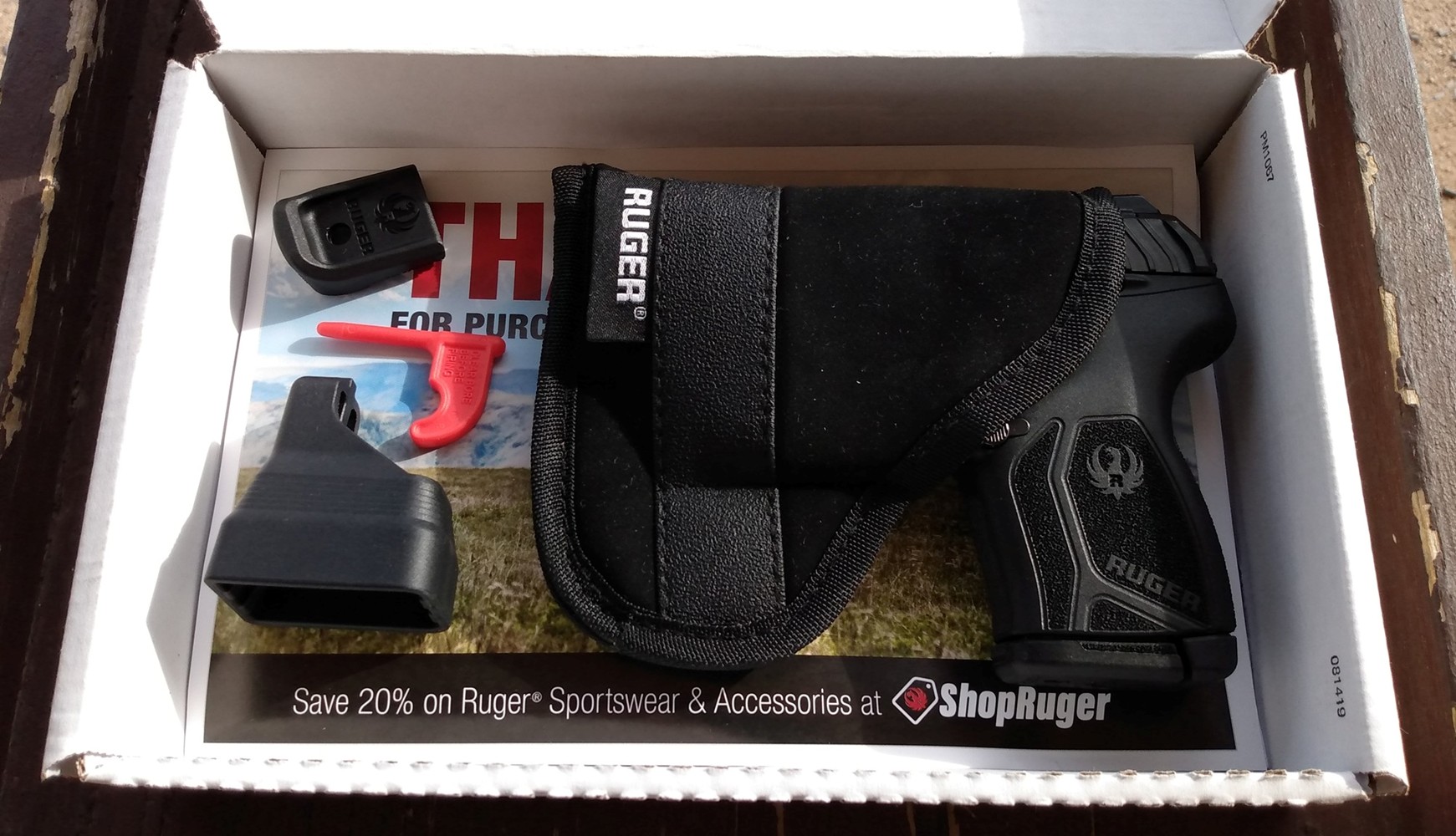
The LCP Max ships in a simple cardboard box. Included with the gun are
the requisite gun lock, a magazine loader device, a second magazine
floorplate with pinky extension, a chamber flag, and a simple fabric
pocket holster. We’ll talk about pocket holsters a little later.
So let’s do the specs for the LCP Max:
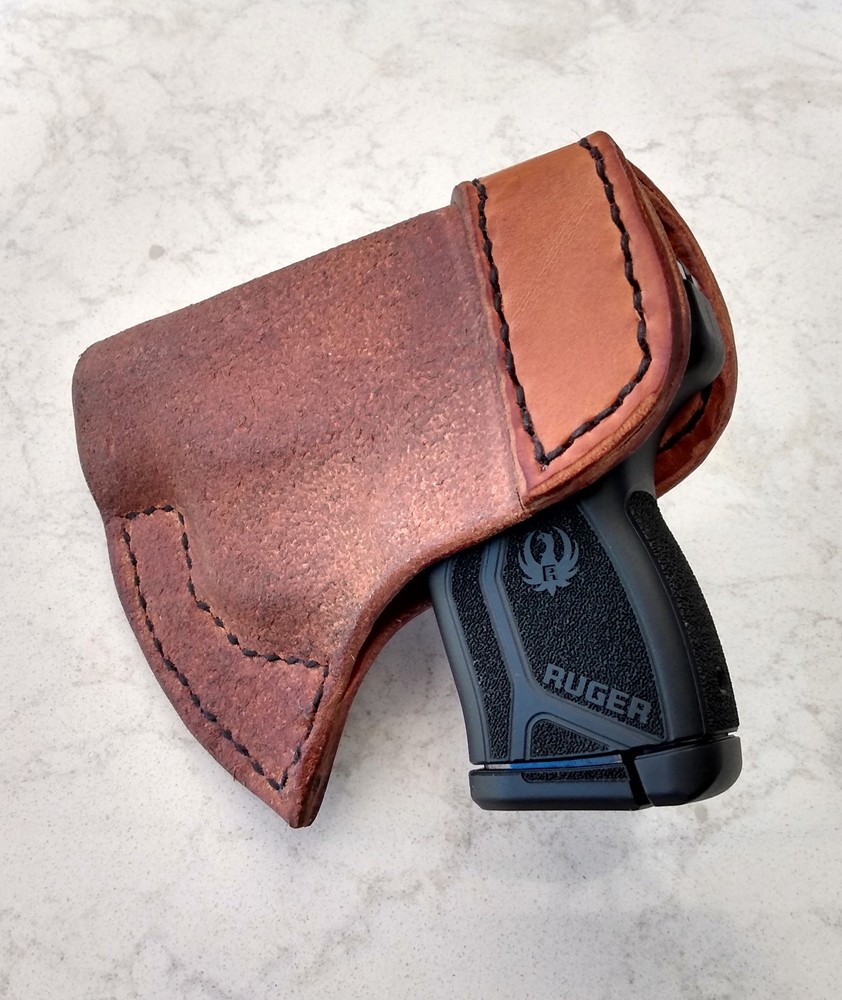
In the Dan-Made leather pocket holster, the pocket width of the LCP Max
is 1.45 inches, and the pocketed weight is 17 ounces.
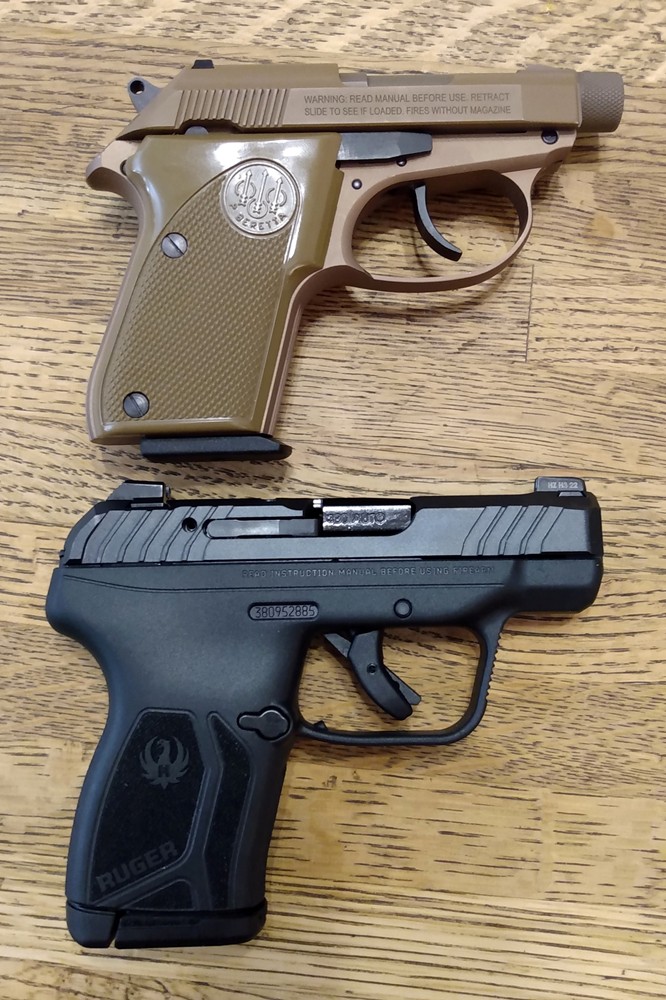
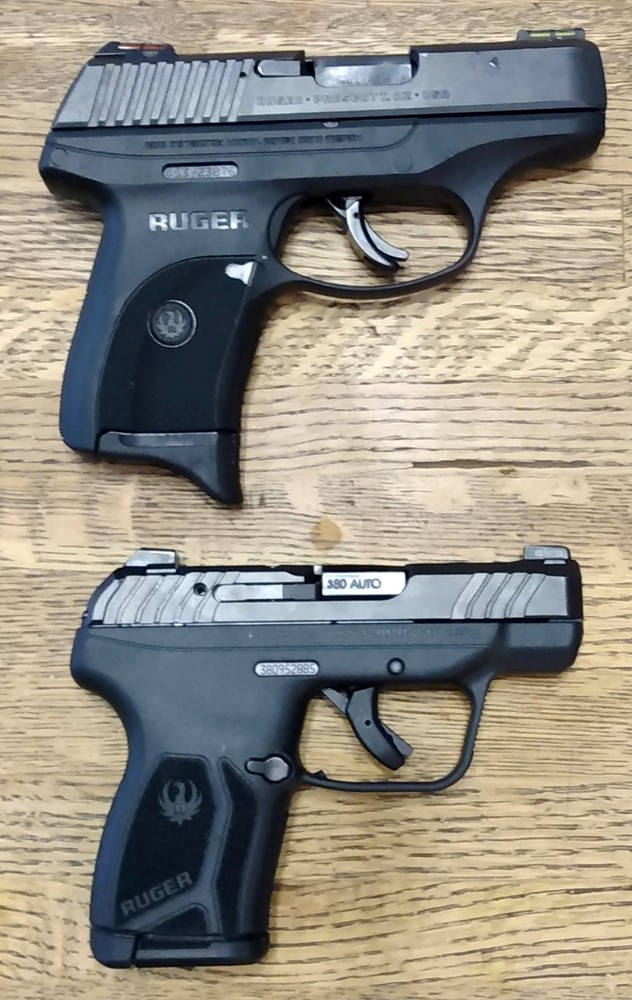
If we compare these numbers to the same figures for the Tomcat from the
perspective of pocket carry, the Ruger LCP Max wins every one of them,
with the exception of overall height – 4.12 inches compared to the
Tomcat’s 3.7 inches.
The pocketed weight advantage is a not insignificant 4 ounces, even
though the Max is holding two extra rounds of heavier ammo. So far
in the Max, I have not chosen to plus-one my carry load by topping
off the magazine after chambering a round. I am happy with 7+1 in
the Tomcat, so why wouldn’t I be happy with 10+0 in the Max?
How DO You Pocket Carry, Anyway?
If you are lucky enough to see trouble coming before it gets to you,
the posture of having your hands in your front pockets is casual and
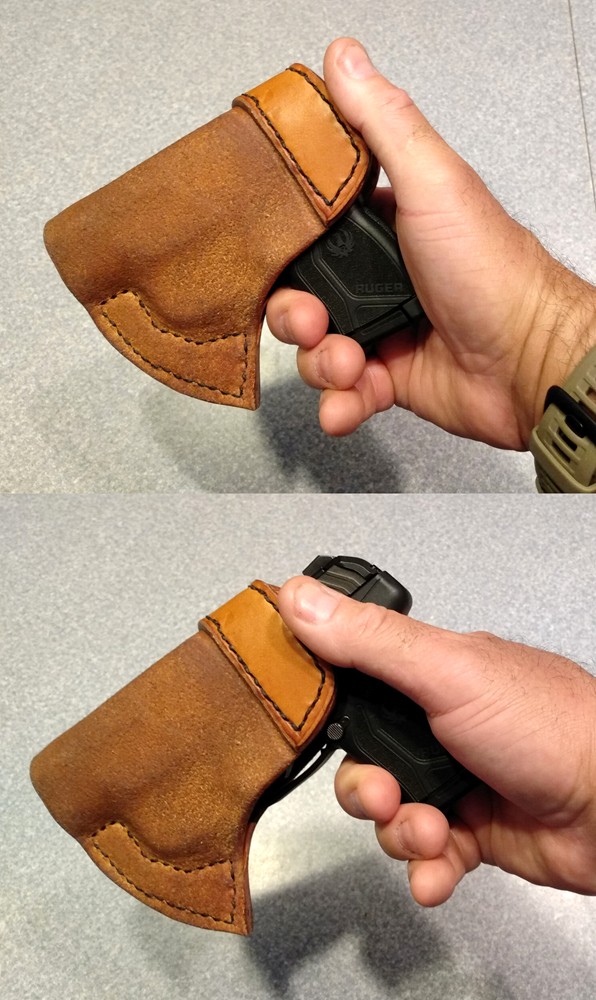
non-threatening. Yet, you can have your strong hand wrapped around
the grip ready to draw in one quick motion. You can pre-stage the
draw. What I mean by that, is that you can break the gun free of the
pocket holster before you pull it out of the pocket. This prevents
the holster from coming out of your pocket with the draw.
Hand-in-pocket draw is faster than having to sweep away a cover garment
to draw from a strong side inside-the-waistband (IWB) or
outside-the-waistband (OWB) holster. It’s even faster than having to
first pull up your shirt for appendix-inside-the-waistband (AIWB) carry.
This is one big advantage of front pocket carry. The disadvantage though,
is that it works best with the smallest and lightest CCW guns on the
market, with their weaker calibers.
Third, your pocket holster must completely cover and protect the trigger
from accidental activation.
Fourth, a good pocket holster will allow a quick draw from the pocket by
releasing from the gun when the gun is drawn, with the holster staying
behind inside the pocket. That is the reason for the hook design of my
leather holster.
The cloth holster that comes with the Max is problematic. It has a secure
retention fit on the Max from the top of the slide to the bottom of the
trigger guard. It is impossible to draw the gun from the pocket without
the holster coming out with the gun. You then have the extra step of
stripping the holster from the gun after the draw. That costs you time,
and it puts your weak hand in front of the muzzle. Retention is not a
desired feature of a pocket holster. Being inside your pocket in the
first place, is your retention.
When pocket carrying, it is important that the gun pocket be reserved
for the gun, and used for nothing else. Keys, loose change, and sticks
of gum should go into your weak-hand pocket.
Resist the temptation to fiddle with the gun inside your pocket. Keep
your hand out of that pocket unless you perceive an imminent threat.
A good pocket holster should keep your gun secure and correctly
positioned at all times, so you don’t need to keep checking on it.
I have been practicing my pocket draw with an empty gun in the house.
But I need to get out in the wild to perform some timed live-fire
practice. I got these pocket guns only after the summer fire
restrictions were instituted on the public lands, so I have not yet
been able to do that. But it is high on my list of priorities once
the restrictions are lifted. This is not something you are allowed to
do at most public ranges. I will practice drawing both starting with
hand in pocket, and with the hand outside the pocket.
I built the Tomcat holster first, with the rough side in. When I made
the LCP holster, I decided to put the smooth side inside and the rough
side out. This creates more friction with the pocket and less with gun,
for cleaner draw.
Though the two guns are basically the same size, the Tomcat has a
pointier nose than the Max. The Max’s nose is boxier, so it would not
seat well in the Tomcat’s holster. That gave me the opportunity to try
again. The Max’s holster ended up being an improvement over the Tomcat’s.
I used the same pattern, only the shape of the stitching needed to be
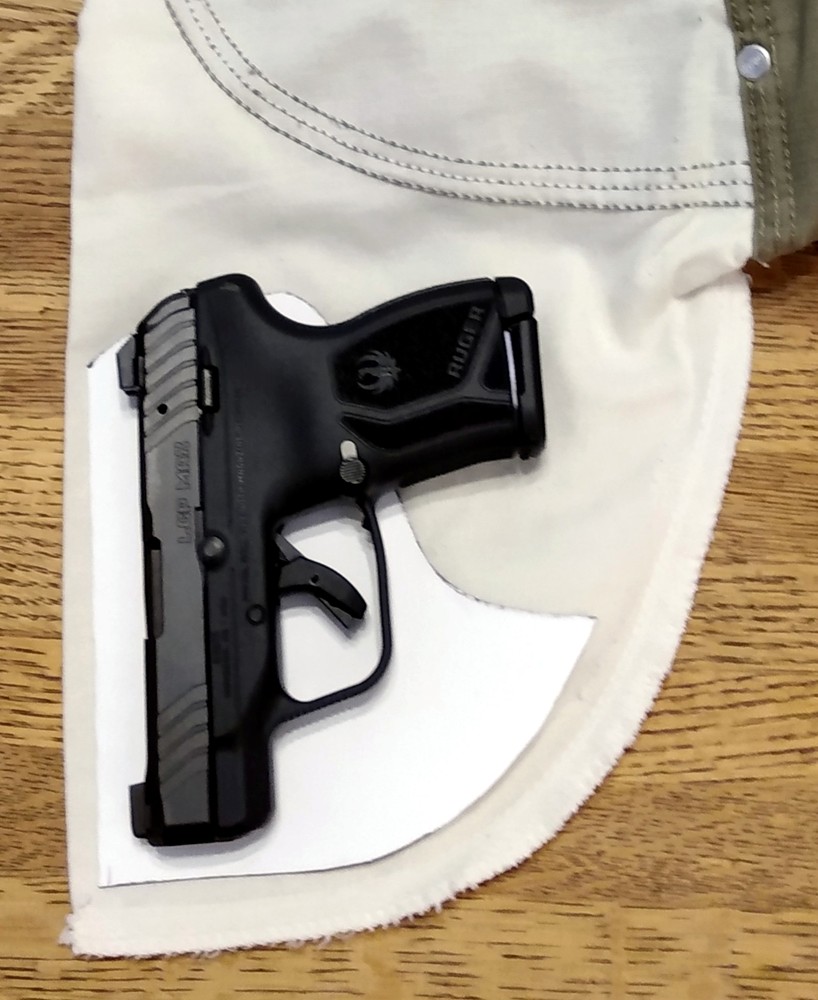
different. To develop the pattern. I started by cutting out a piece
of folded-over paper to follow the curve of the pocket of my favorite
shorts. The shape of the stitching in the hook area of the holster is
what locates and stops the gun along the front and bottom of the trigger
guard. Since the holster follows the shape of the pocket, you can see
how the holster locks in position inside the pocket to keep the gun in
a stable position.
I finished the Tomcat’s holster with neatsfoot oil. This resulted in a
soft holster. When I made the LCP’s holster, I wet-molded it to the gun.
This makes the finished product more hard shell that perfectly fits the
contours of the gun. Then I applied a wax-based leather dressing inside
and out. The Max’s holster draws much better than the Tomcat’s.
Shooting the Pocket Rockets
The heavier, longer break of the Max’s trigger may cause me to twist or
bob as the trigger breaks. I need to put the Max on paper with a rest to
see whether or not I might need to try drifting the sights.
But of course, 50 yard silhouette shooting is not what these guns are for.
But if I can hit, or at least get close at 50 yards, then hitting at 7 yards
should be easy.
Both the Tomcat and the LCP Max are real guns when it comes to both recoil
and report. With the light gun weight, you feel the recoil. However,
even with only the two finger grip that these guns allow, controllability
in recoil was not an issue for me. I suspect that they could give trouble
to someone with weaker grip strength.
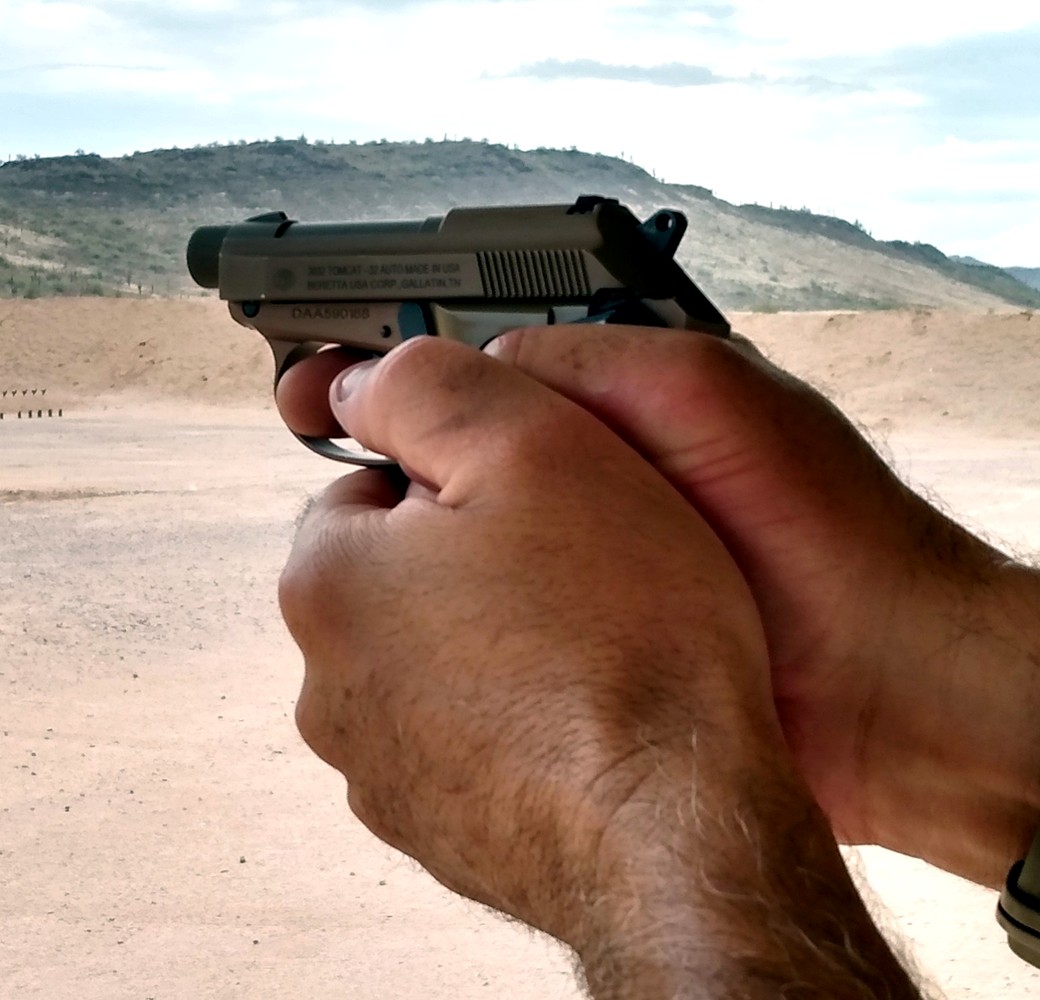
Getting a good two-hand grip on guns this tiny can be a challenge. Some
bigger guys with fat hands who employ a high hold could have a problem
with slide bite. The Tomcat is more prone to this problem than the Max
because the bottom edge of the slide is closer the grip’s web radius
beneath the beavertail, than it is on the Max.
With these tiny guns, people who employ the trendy thumbs forward grip
could interfere with slide travel. Again, the Tomcat could be more prone
to this problem because there just isn’t much front-end frame real estate
available for the placement of your weak hand’s thumb.
My natural two handed grip puts my weak hand thumb on top of my dominant
hand’s thumb. This keeps all my fleshy parts well away from the moving
machinery, but that grip also puts the recoil axis higher, exaggerating
perceived recoil. This is worse on the LCP Max, first, because its bore
axis is higher from the web of your hand than the Cat’s; and second,
because it fires a slightly more powerful cartridge.
One other bother I have with the LCP Max is that the bottom of the trigger
guard at the top of the grip uncomfortably impinges on the top of my middle
finger. It’s like I want my middle finger to get higher on the grip than
the trigger guard allows. No such issue on the Tomcat.
The Tomcat has a thicker, more rounded interface with the web of your hand.
With its lower bore axis, and its milder cartridge, overall I find the
Tomcat is more comfortable to grip and to shoot.
Wrapping Up
Let us compare weights of a few pocket carry options. Empty, the LCP Max
is only 10.6 ounces. The LC9S weighs 17.2 ounces empty. Now add-in ammo
weight: 10 rounds of .380 ACP weighs 3.4 ounces. The LC9s holds 7 in the
magazine plus one in the chamber. 8 rounds of 115 grain 9mm ammo weighs
3.3 ounces. The new Ruger Max-9 is about the same size as the LC9S but
has a double stack magazine. It matches the LCP Max for capacity with a
10 or 12 round (extended) magazine. But it weighs 18.4 ounces empty.
10 rounds of 9mm weighs 4.2 ounces.
Totaling things up, loaded, no holster:
Pocket carry is all about convenience. You’ll often hear it said, that
it’s better to have a small gun with you, instead of the big one you left
at home because it was too much of a burden. Size and weight matter.
| |||||||||||||||||||||||||||||||||||||||||||||||
| If you enjoyed this story, or found it useful, please consider clicking here to join the NRA at a discount of $15 off the normal membership cost. You will be supporting both this website and adding your voice in support of the Second Amendment. Thank you very much. |

|
|
|